
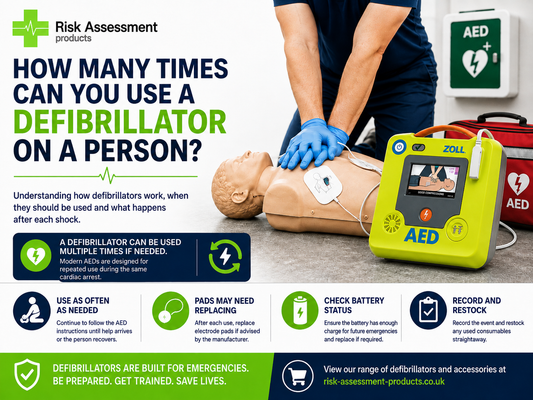
How many times can you use a defibrillator on a person?
There is no fixed number of times an automated external defibrillator (AED) can be used on a person during a cardiac arrest.
If the AED continues to detect a shockable heart rhythm, it may advise more than one shock during the same emergency.
The important thing is not to count the shocks. Keep following the AED’s instructions, continue CPR when told to do so and allow the device to decide whether another shock is needed.
An AED analyses the person’s heart rhythm before every shock. It will only advise or deliver a shock when it detects a rhythm suitable for defibrillation.
Can a Defibrillator Shock Someone More Than Once?
Yes.
It is completely normal for an AED to analyse the heart more than once and potentially recommend several shocks during a single resuscitation attempt.
A typical AED sequence is:
- The AED analyses the person’s heart rhythm.
- If a shockable rhythm is detected, it advises a shock.
- A semi-automatic AED asks the rescuer to press the shock button, while a fully automatic model delivers the shock automatically after warning everyone to stand clear.
- The AED tells the rescuer to immediately restart CPR.
- After a period of CPR, the AED analyses the heart rhythm again.
- If the rhythm remains shockable, another shock may be advised.
This cycle can continue for as long as the AED considers further shocks appropriate.
Is There a Maximum Number of Defibrillator Shocks?
For a member of the public using an AED, there is no predetermined maximum number of shocks that you need to count.
The AED makes the decision.
If another shock is appropriate, it will tell you.
If the heart rhythm is no longer shockable, the AED will say that no shock is advised and instruct you to continue CPR.
The safest approach is therefore simple:
Switch the AED on and continue following its spoken or visual instructions until professional help takes over.
Why Does an AED Analyse the Heart After Each Period of CPR?
The heart rhythm can change during a cardiac arrest.
A rhythm that was shockable may become non-shockable, while another rhythm may later become suitable for defibrillation.
The AED therefore re-analyses the heart at intervals rather than delivering repeated shocks continuously.
During the periods between analyses, the AED normally instructs rescuers to perform CPR.
Keeping interruptions to chest compressions as short as possible is important.
What Happens After a Defibrillator Delivers a Shock?
Immediately after the shock, restart CPR when the AED tells you to do so.
Do not stop to check whether the shock has worked unless the AED or emergency services instruct you otherwise.
For adult CPR, chest compressions should be given:
- at 100–120 compressions per minute;
- to a depth of at least 5 cm but no more than 6 cm; and
- with interruptions kept to a minimum.
If you are trained and willing to provide rescue breaths, use 30 chest compressions followed by 2 rescue breaths.
The AED will tell you when it needs to analyse the heart rhythm again.
What Happens if the AED Says “No Shock Advised”?
A “no shock advised” message does not necessarily mean the person has recovered.
It means the AED has not detected a heart rhythm that should be treated with a shock at that moment.
Immediately restart CPR and continue following the AED instructions.
The device may analyse the heart rhythm again later.
Can You Use a Defibrillator Too Many Times?
You should not avoid an advised shock because you are worried that the person has already received too many.
An AED is designed to analyse the heart rhythm and determine whether defibrillation is appropriate.
The rescuer’s role is to:
- switch the AED on;
- attach the electrode pads correctly;
- continue CPR when instructed;
- stand clear when the AED analyses the heart;
- deliver the shock if instructed by a semi-automatic AED; and
- continue following the device prompts.
The AED controls whether another shock is advised.
Can an AED Shock Someone Who Does Not Need a Shock?
An AED analyses the electrical rhythm of the heart before deciding whether a shock is appropriate.
If it does not detect a shockable rhythm, it will not instruct the rescuer to deliver a shock.
Modern public-access AEDs are designed so that the user does not need to diagnose the heart rhythm themselves.
This is one of the reasons anyone can use an AED, even without previous defibrillator training.
When Should You Stop Using the Defibrillator?
Once the AED has been attached during a suspected cardiac arrest, continue to follow its instructions.
Continue CPR and AED use until:
- the ambulance service or another healthcare professional takes over;
- the person shows clear signs of life and is breathing normally;
- the AED or emergency call handler instructs you otherwise; or
- you are physically unable to continue.
If other rescuers are available, rotate the person performing chest compressions where possible to reduce fatigue while keeping interruptions short.
What Happens to the AED Pads After Use?
This is where the question of “how many times” becomes commercially important.
Most standard AED electrode pads used during a rescue are single-use consumables.
Once they have been removed from their sealed packaging and attached to a casualty, they will normally need to be replaced before the AED can be returned to emergency-ready status.
Always follow the manufacturer’s instructions for your particular AED and pad type.
Risk Assessment Products supplies replacement electrode pads for many leading AED manufacturers.
Does the AED Battery Need Replacing After Use?
Not necessarily.
AED batteries are designed to provide a particular operating life and capacity, and a single deployment does not automatically mean the battery must be replaced.
However, after an AED has been used you should:
- check the device’s readiness indicator;
- review any manufacturer instructions;
- check the remaining battery status where the model allows;
- replace the battery if the device indicates this is required; and
- make sure the AED passes its self-test before returning it to service.
Some batteries have a specified standby life, while others may also have limits based on usage or the number of shocks delivered.
What Should You Do With a Defibrillator After It Has Been Used?
After an AED has been deployed, it should be checked before being returned to service.
A practical post-use check should include:
- Confirm the AED has been returned to its normal location.
- Replace used electrode pads.
- Check the battery and readiness indicator.
- Inspect the AED and carrying case for damage or missing items.
- Replace any other used consumables, such as a rescue kit where applicable.
- Clean the device in accordance with the manufacturer’s instructions.
- Check expiry dates on replacement pads and other consumables.
- Confirm the AED is displaying its normal ready status.
- Update The Circuit if the AED is registered there and had been marked as deployed or unavailable.
The defibrillator should only be considered ready for another emergency once all required consumables have been replaced and the device indicates that it is operational.
Keep Your AED Emergency Ready
An AED may sit unused for years and then be needed without warning.
Regular checks help identify problems such as:
- expired electrode pads;
- depleted batteries;
- damaged equipment;
- missing rescue accessories; or
- a failed readiness indicator.
For a practical maintenance guide, read:
How Often Should a Defibrillator (AED) Be Checked?
You can also use our:
to help keep a record of routine AED checks.
Do You Need Spare Defibrillator Pads?
For workplaces, schools, sports facilities and public-access AED locations, keeping replacement pads available can help reduce the time an AED remains out of service after a deployment.
When purchasing replacement pads, make sure they are compatible with the exact make and model of defibrillator.
Also check:
- pad expiry date;
- adult or paediatric suitability;
- whether the AED uses separate child pads or a paediatric mode; and
- the manufacturer’s storage requirements.
Browse Replacement Defibrillator Pads
Does a Defibrillator Need Servicing After Every Use?
Not necessarily.
Many modern AEDs carry out automatic self-tests and display a status indicator showing whether the device is ready for use.
Following a deployment, however, the AED should still be inspected and any used or depleted consumables replaced in accordance with the manufacturer’s instructions.
If the device shows a fault or does not return to its normal ready status, contact the manufacturer or supplier for advice before returning it to service.
Should a Used Defibrillator Be Updated on The Circuit?
Yes, if your public-access AED is registered on The Circuit, its status should accurately reflect whether it is available for use.
If an AED has been deployed and is temporarily not emergency ready because pads or other consumables need replacing, its status should be updated.
Once it has been checked, restocked and returned to its normal location, its record can be returned to Emergency Ready.
Keeping this information up to date helps ambulance services know which registered defibrillators are available during an emergency.
Can a Defibrillator Be Used on More Than One Person?
Yes, the AED unit itself can generally be used again after an incident once it has been checked and returned to emergency-ready condition.
However, consumables used during the first rescue may need replacing before the AED can be used again.
This will normally include the electrode pads.
The battery should also be checked to ensure the AED is ready for another emergency.
How Long Can a Defibrillator Be Used During a Cardiac Arrest?
There is no simple time limit that a rescuer needs to monitor.
Once the AED has been attached, continue following its instructions and performing CPR until the ambulance service or another healthcare professional takes over, the casualty recovers sufficiently, or you are told to stop.
The AED will continue to analyse the heart rhythm at appropriate intervals and advise whether further shocks are required.
Recent Posts
-
Is One Defibrillator Enough? AED Coverage for Large UK Workplaces
Having a defibrillator on site is an important step towards workplace emergency preparedness. But wh …16th Oct 2026 -
Mobile First Aid Storage: Wheeled First Aid Cabinets for Large Workplaces
When an emergency happens, first aid equipment needs to be accessible, wherever the incident occurs. …8th Oct 2026 -
LUCAS 3 Mechanical CPR: When Every Compression Counts
During cardiac arrest, high-quality chest compressions with minimal interruptions are essential. But …2nd Oct 2026