
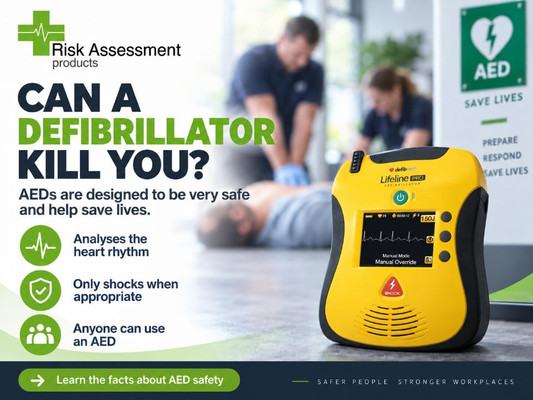
Can a defibrillator kill you?
Automated external defibrillators (AEDs) are designed to be very safe, and the risk of serious harm from using one correctly is extremely low.
An AED analyses the electrical rhythm of the heart before deciding whether a shock is appropriate. It will only advise or deliver a shock when it detects a rhythm suitable for defibrillation.
For someone who is unresponsive and not breathing normally, the greater danger is delaying CPR and defibrillation.
Current Resuscitation Council UK guidance states that anyone can use an AED.
Can an AED Shock Someone Who Does Not Need It?
An AED is designed to prevent this.
Before any shock is advised, the device analyses the person’s heart rhythm.
If the rhythm is not shockable, the AED will not tell the rescuer to deliver a shock.
Resuscitation Council UK states that AEDs are safe for public use and will not allow a shock to be given to someone who does not require one.
This means you do not need to diagnose the heart rhythm yourself.
The AED does that for you.
What Happens When a Defibrillator Delivers a Shock?
A defibrillator does not simply “restart” a completely stopped heart.
It delivers a controlled electrical shock when it identifies certain abnormal heart rhythms that can benefit from defibrillation.
The shock is intended to interrupt the abnormal electrical activity and give the heart an opportunity to return to an organised rhythm.
For a fuller explanation, read:
Does a Defibrillator Restart a Stopped Heart?
Can the Shock From an AED Harm the Casualty?
The shock itself is a necessary treatment when the AED identifies a shockable cardiac arrest rhythm.
The person is already in a life-threatening emergency.
Public-access AEDs are specifically designed to analyse the heart rhythm and only advise defibrillation when it is appropriate.
The risk of significant harm from AED use is very low compared with the risk of doing nothing during cardiac arrest. Resuscitation Council UK advises members of the public not to be afraid to use an AED when someone is in cardiac arrest.
Can a Defibrillator Shock the Person Using It?
The risk to the rescuer is very low when the AED is used correctly.
The important safety rule is:
Nobody should be touching the casualty when the AED is analysing the rhythm or delivering a shock.
The AED will normally tell rescuers to stand clear before analysis and shock delivery.
Resuscitation Council UK notes that injury to a CPR provider from defibrillator shock is extremely rare.
Is It Safe to Use an AED on a Wet Person?
Usually, yes.
If the casualty is wet, dry the chest so the adhesive AED pads can stick properly.
An AED can generally be used if the person is on a wet, metallic or other conductive surface, provided the pads are correctly attached and nobody is touching the casualty when the shock is delivered.
Do not delay defibrillation unnecessarily.
Is It Safe to Use an AED on a Metal Surface?
Yes, in most circumstances.
The key is to ensure:
- the electrode pads are firmly attached to the casualty’s bare chest;
- nobody is touching the casualty during analysis or shock delivery; and
- you continue to follow the AED instructions.
Resuscitation Council UK states that AED use is usually safe on metallic and other conductive surfaces.
Can You Use a Defibrillator on a Child?
Yes.
An AED can be used on children.
For children under approximately 8 years old or 25 kg, current Resuscitation Council UK guidance recommends using a paediatric mode or attenuated shock setting where available.
If a paediatric setting is not available, do not delay defibrillation — use the AED in standard adult mode.
Some AEDs use:
- separate paediatric electrode pads;
- a child key;
- a child button or switch; or
- a paediatric mode using the same pads.
Always follow the instructions for the particular AED being used.
What if the Child Is Very Small?
When using adult-size AED pads on a small child, the pads should not touch each other.
For smaller children, Resuscitation Council UK guidance recommends an anteroposterior position where necessary:
- one pad on the front of the chest; and
- one pad on the back between the shoulder blades.
Can You Use an AED on a Pregnant Woman?
Yes.
Cardiac arrest during pregnancy is rare, but an AED should still be used if needed.
Resuscitation Council UK states that AED use is appropriate in pregnancy.
The pads should be placed in the normal positions but kept clear of enlarged breast tissue where possible.
Pregnancy is not a reason to delay CPR or defibrillation.
Can Anyone Use an AED?
Yes.
Public-access AEDs are designed for use by members of the public, including people who have never used one before.
The AED guides the rescuer through the process using spoken and/or visual instructions.
You do not need to:
- diagnose the rhythm;
- decide whether a shock is required; or
- have medical qualifications.
Current UK guidance explicitly states that anyone can use an AED.
Training can improve confidence and familiarity, but lack of training should not stop you from using one in an emergency.
What Should You Do if Someone Collapses?
If someone is unresponsive:
- Call 999 immediately.
- Assess whether they are breathing normally.
- If they are unresponsive and not breathing normally, start CPR.
- Send someone to get an AED if one is available.
- Switch the AED on.
- Attach the pads to the bare chest as shown.
- Follow the AED instructions.
- Make sure nobody is touching the casualty when the AED analyses the rhythm or delivers a shock.
- Resume CPR immediately when instructed.
Current Resuscitation Council UK guidance says to start chest compressions as soon as possible and use an AED as early as possible.
What if the AED Says “No Shock Advised”?
Do not assume the casualty has recovered.
A “no shock advised” message means the AED has not detected a rhythm suitable for defibrillation at that moment.
Immediately restart CPR unless the casualty is clearly showing signs of life and breathing normally.
The AED will continue to guide you and may analyse the heart rhythm again later.
Can You Accidentally Kill Someone by Using an AED?
The risk of causing serious harm by correctly using a public-access AED is extremely low.
The AED is designed to prevent inappropriate shocks by analysing the heart rhythm before allowing defibrillation.
During suspected cardiac arrest, delaying CPR and AED use is the greater risk.
If the person is unresponsive and not breathing normally:
Call 999, start CPR and use the AED.
Why People Should Not Be Afraid to Use an AED
One of the biggest barriers to public AED use is fear of doing something wrong.
Modern AEDs are designed to make the process as straightforward as possible.
They:
- analyse the heart rhythm automatically;
- tell you where to place the pads;
- tell you when to stand clear;
- decide whether a shock is appropriate;
- guide you back to CPR; and
- continue giving instructions throughout the emergency.
The important thing is to act.
Semi-Automatic vs Fully Automatic AEDs
Both types analyse the heart rhythm automatically.
Semi-Automatic AED
A semi-automatic AED tells the rescuer when a shock is required and asks them to press the shock button.
Shop Semi-Automatic Defibrillators
Fully Automatic AED
A fully automatic AED analyses the rhythm and delivers the shock automatically after warning rescuers to stand clear.
Shop Fully Automatic Defibrillators
Both are designed for straightforward use during a cardiac arrest.
Should Workplaces Have an AED?
There is no general UK law requiring every workplace to provide an AED.
However, organisations can consider AED provision as part of their first-aid needs assessment.
Factors may include:
- number of employees and visitors;
- site size;
- access to emergency medical services;
- physical activity taking place;
- existing nearby AED provision; and
- how quickly a defibrillator could reach a casualty.
Our Free Defibrillator Site Assessment Form can help organisations assess AED provision, location and accessibility.
Where Should an AED Be Kept?
An AED should be:
- easy to find;
- clearly signposted;
- readily accessible;
- maintained in emergency-ready condition; and
- protected appropriately for its environment.
For public-access AEDs, current Resuscitation Council UK guidance recommends clear signage, unlocked cabinets and 24/7 access where possible.
Risk Assessment Products supplies:
and
for indoor and outdoor AED installations.
Frequently Asked Questions
Can a defibrillator kill someone?
AEDs are designed to be very safe. They analyse the heart rhythm and only advise or deliver a shock when a shockable rhythm is detected. The risk of serious harm from correct AED use is very low.
Can an AED shock someone who does not need it?
AEDs are designed not to allow a shock unless they detect a rhythm suitable for defibrillation.
Can the rescuer get electrocuted?
The risk is very low. Make sure nobody is touching the casualty when the AED is analysing the rhythm or delivering a shock.
Can you use an AED in the rain?
AED use is generally safe in wet conditions, but dry the casualty’s chest so the pads will adhere properly and do not touch the casualty during shock delivery.
Can you use a defibrillator on a child?
Yes. Use paediatric mode or attenuated settings for children under approximately 8 years or 25 kg where available. If not available, do not delay - use the AED in standard adult mode.
Can you use an AED on a pregnant woman?
Yes. Pregnancy is not a reason to withhold or delay defibrillation.
Do you need training to use a defibrillator?
No. Anyone can use an AED. Training can improve confidence, but public-access AEDs are designed to guide inexperienced rescuers.
AEDs Are Designed to Save Lives
A defibrillator should not be something people are afraid to use.
Public-access AEDs are designed to:
- analyse the heart rhythm;
- prevent inappropriate shocks;
- guide the rescuer;
- support CPR; and
- deliver defibrillation when it is needed.
If someone is unresponsive and not breathing normally, call 999, start CPR and use an AED as soon as possible.
Risk Assessment Products supplies:
- Defibrillators & AEDs
- Defibrillator Packages
- AED Cabinets & Cases
- AED Trainers
- CPR Training Manikins
For organisations unsure which AED is suitable, contact Risk Assessment Products for product advice.
Recent Posts
-
Is One Defibrillator Enough? AED Coverage for Large UK Workplaces
Having a defibrillator on site is an important step towards workplace emergency preparedness. But wh …16th Oct 2026 -
Mobile First Aid Storage: Wheeled First Aid Cabinets for Large Workplaces
When an emergency happens, first aid equipment needs to be accessible, wherever the incident occurs. …8th Oct 2026 -
LUCAS 3 Mechanical CPR: When Every Compression Counts
During cardiac arrest, high-quality chest compressions with minimal interruptions are essential. But …2nd Oct 2026