
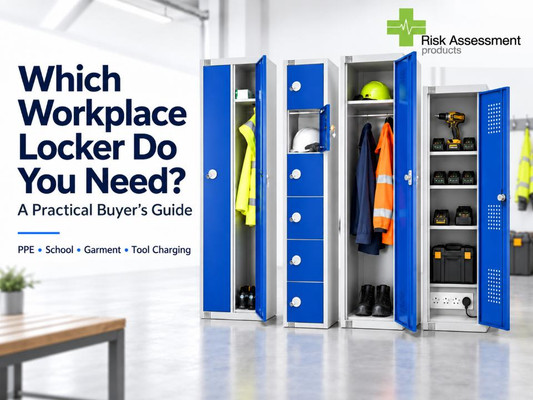
Which Workplace Locker Do You Need? A Practical Buyer’s Guide
Buying lockers for a workplace, school or changing facility can look straightforward until you start comparing the different configurations available.
Do your employees need somewhere for coats and bags? Are you issuing PPE or workwear? Do several people need smaller individual compartments? Are you trying to maximise storage in a restricted space? Or do tools and batteries need secure storage while they are being charged?
Choosing the right locker starts with what needs to be stored, who needs access and where the lockers will be installed.
At Risk Assessment Products, our workplace locker range includes solutions for personal belongings, uniforms, PPE, tools, workwear and shared storage.
Looking for lockers now? Browse our complete Workplace Lockers range.
Which Type of Locker Is Right for Your Organisation?
| Requirement | Locker typer to consider |
| Individual storage for staff or visitors | Compartment Lockers |
| Coats, uniforms and hanging garments | Garment Lockers |
| Phones, wallets, keys and small belongings | Personal Effects Lockers |
| Schools and education settings | School Lockers |
| Restricted changing-room or workplace space | Space Saving Lockers |
| Power tools, batteries and portable equipment | Tool Charging Lockers |
| Uniform and work clothing management | Workwear Lockers |
| Personal protective equipment | PPE Lockers |
Here is how the different options compare.
Compartment Lockers - More Users in Less Floor Space
Best for: offices, factories, warehouses, leisure facilities, healthcare workplaces and shared staff areas.
Compartment lockers divide the available storage space into multiple individually accessible sections.
They are particularly useful where every user needs secure personal storage but does not require a full-height locker.
Typical uses include storing:
- Bags and personal belongings
- Phones and valuables
- Small pieces of work equipment
- Staff possessions during a shift
- Visitor or temporary worker belongings
For workplaces with large numbers of employees, multi-compartment storage can also make much better use of the available floor space.
Garment Lockers - Storage for Clothing and Uniforms
Best for: manufacturing, healthcare, hospitality, food production, engineering and businesses supplying employee uniforms.
Garment lockers are designed around clothing rather than simply providing a secure box.
They can be particularly useful where employees need to store work clothing, uniforms or personal garments during their shift.
Specialist garment dispensing and service lockers can also support organisations operating managed workwear or laundry systems.
This makes them relevant to businesses where uniform control and clothing distribution form part of day-to-day operations.
Personal Effects Lockers - Secure Storage for Smaller Belongings
Not every employee needs a full-size locker.
For workplaces where staff mainly need somewhere for phones, wallets, keys and other personal possessions, a personal effects locker can provide a more space-efficient alternative.
Risk Assessment Products offers both:
Floor-Standing Personal Effects Lockers
Suitable where larger banks of personal storage are required and sufficient floor space is available.
Shop Floor-Standing Personal Effects Lockers
Wall-Mountable Personal Effects Lockers
A useful option where floor space is limited or personal storage needs to be positioned conveniently within an existing workplace.
They can work particularly well in offices, staff rooms, reception areas and other locations where small-item storage is required without installing conventional full-height lockers.
Shop Wall-Mountable Personal Effects Lockers
School Lockers - Storage Designed Around Education
Best for: secondary schools, colleges, academies, universities and other educational facilities.
School lockers provide pupils and students with dedicated storage for belongings during the day and can help reduce the amount of equipment that has to be carried between lessons.
When specifying lockers for an education environment, consider:
- Number of students requiring storage
- Available corridor or changing-room space
- Required compartment size
- Locker configuration
- Locking method
- Colour requirements
- How banks of lockers will fit within the available area.
For larger projects, planning the required number and configuration before ordering can make installation considerably easier.
Space Saving Lockers - When Floor Space Is at a Premium
Best for: changing rooms, leisure centres, factories, healthcare environments and compact staff facilities.
Providing every employee with adequate storage can become difficult when floor space is limited.
Space saving lockers are designed to increase the number of people who can be provided with storage within the available footprint.
They are particularly worth considering when planning or refurbishing:
- Staff changing rooms
- Factory changing facilities
- Gyms and leisure facilities
- Healthcare staff areas
- Warehouses
- Compact welfare facilities.
Rather than automatically choosing conventional single-door lockers, compare how many users different locker configurations can accommodate within the same available wall space.
Tool Charging Lockers - Secure Storage While Equipment Charges
Best for: construction, engineering, maintenance, manufacturing, facilities management and workshops.
Cordless tools and portable equipment have created a different workplace storage requirement: equipment may need secure storage and access to power at the same time.
Tool charging lockers combine individual storage compartments with electrical charging provision.
They can be particularly useful for organisations managing multiple cordless tools, batteries or portable workplace devices across employees or shifts.
Instead of leaving equipment unsecured around a workshop or charging area, a dedicated charging locker can help bring tool storage and charging together in one location.
For facilities managers, contractors and engineering businesses, this is one of the more specialist locker categories worth considering.
Workwear Lockers - Organise Employee Clothing
Best for: factories, manufacturing, engineering, warehousing, healthcare and businesses with issued work clothing.
Where employees change into work clothing on site, conventional personal storage may not always be the best solution.
Workwear lockers are intended for environments where uniforms, protective clothing and employees' own clothes need to be organised within changing facilities.
Before ordering, think about:
- How much clothing each employee needs to store
- Whether clean and used clothing need to be managed differently
- Whether employees need hanging space
- The number of employees per shift
- Available changing-room space.
Choosing the correct configuration at the outset can produce a much more practical changing area.
PPE Lockers - Dedicated Storage for Protective Equipment
Best for: manufacturing, construction, engineering, utilities, warehouses, workshops and industrial sites.
Personal protective equipment needs somewhere appropriate to be stored when it is not being worn.
PPE lockers provide dedicated workplace storage for equipment such as protective clothing and other issued PPE.
They can be particularly relevant where employers provide equipment to individual employees or need designated storage locations within changing rooms and operational areas.
Different compartment configurations allow businesses to choose between larger individual storage areas and multiple smaller sections depending on the equipment being issued.
Who Typically Buys Workplace Lockers?
Locker purchasing often forms part of a wider facilities, refurbishment, expansion or workplace safety project.
Typical buyers include:
- Facilities managers upgrading staff welfare or changing facilities
- Estates managers responsible for multiple buildings
- School business managers and education procurement teams
- Health and safety managers organising PPE and workwear
- Manufacturing and operations managers equipping factories and production facilities
- Warehouse managers providing employee and PPE storage
- Construction companies needing storage for PPE, tools and equipment
- Leisure and hospitality operators providing changing and staff facilities
- Procurement teams sourcing workplace equipment across multiple sites
- Fit-out and refurbishment contractors specifying storage as part of larger projects
The right choice therefore depends as much on the environment and number of users as it does on the locker itself.
Five Questions to Answer Before Ordering Lockers
Before comparing products, establish:
1. What will actually be stored?
A phone and wallet require very different storage from a coat, hard hat or power tool.
2. How many people need a locker?
Consider total headcount as well as shift patterns. Not every organisation needs one full-size locker for every employee.
3. How much space is available?
Measure the proposed location carefully and consider both width and depth as well as circulation space around the lockers.
4. Does the application require a specialist locker?
PPE, workwear, garment management and tool charging can all justify choosing a purpose-designed solution rather than a standard locker.
5. Is this a single purchase or part of a larger project?
For changing rooms, new sites, school refurbishments and factory projects, calculate the complete requirement before purchasing individual units. This makes it easier to achieve a consistent layout and specification.
Find the Right Workplace Lockers
There is no single locker configuration that is right for every organisation.
The best solution is the one that gives users enough storage without wasting valuable floor space or paying for capacity that is not required.
Risk Assessment Products supplies workplace lockers for organisations ranging from schools and offices to factories, warehouses, construction businesses and commercial facilities.
Browse our complete range of Workplace Lockers and choose from compartment, garment, personal effects, school, space saving, tool charging, workwear and PPE storage solutions.
Recent Posts
-
Is One Defibrillator Enough? AED Coverage for Large UK Workplaces
Having a defibrillator on site is an important step towards workplace emergency preparedness. But wh …16th Oct 2026 -
Mobile First Aid Storage: Wheeled First Aid Cabinets for Large Workplaces
When an emergency happens, first aid equipment needs to be accessible, wherever the incident occurs. …8th Oct 2026 -
LUCAS 3 Mechanical CPR: When Every Compression Counts
During cardiac arrest, high-quality chest compressions with minimal interruptions are essential. But …2nd Oct 2026