
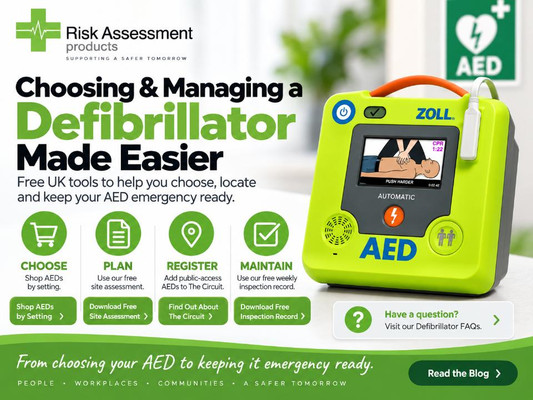
Choosing and Managing a Defibrillator Made Easier: Free AED Tools from Risk Assessment Products
Choosing a defibrillator is only one part of getting AED provision right.
You also need to think about:
- which AED suits the environment;
- where it should be positioned;
- whether it needs a cabinet;
- how quickly it can be accessed;
- who is responsible for checking it;
- when pads and batteries need replacing; and
- whether a public-access AED is registered on The Circuit.
To make this easier, Risk Assessment Products has brought together a range of free AED tools, guides and buying resources to help workplaces, schools, construction sites, community organisations and other locations plan and manage their defibrillator provision.
Start With the Setting, Not Just the AED Specification
AEDs all perform the same fundamental role, but individual models can differ considerably in areas such as:
- IP rating;
- operating temperature;
- durability;
- portability;
- CPR feedback;
- adult and paediatric functionality;
- battery life;
- electrode pad life;
- size and weight; and
- semi-automatic or fully automatic operation.
That is why the best AED for an office may not be the best choice for a construction site, school, leisure centre or outdoor public-access location.
Our Shop AEDs by Setting section allows you to begin with the environment rather than compare every defibrillator on the market.
You can browse AEDs suited to settings including:
- workplaces and offices;
- schools;
- construction sites;
- community locations;
- hospitality;
- leisure facilities;
- dentistry;
- healthcare;
- homes; and
- vehicles.
This is often the simplest way to reduce a large number of AED options to a more manageable shortlist.
Why Does the AED Setting Matter?
The environment can influence both the defibrillator and the accessories needed around it.
For example, an AED in an office may spend its life indoors at a relatively stable temperature.
An AED installed on a construction site may need to cope with:
- dust;
- moisture;
- temperature variation;
- movement between work areas; and
- a more demanding physical environment.
A community AED installed outdoors may also require a suitable weather-resistant cabinet and clear signage.
Choosing the AED and storage arrangement together can therefore be more effective than treating them as separate decisions.
Not Sure Which Defibrillator to Choose?
Before buying, useful questions include:
- Do you want a fully automatic or semi-automatic AED?
- Will the AED be used indoors or outdoors?
- Is paediatric use likely?
- Is CPR feedback important?
- How long do the pads last?
- How long does the battery last?
- Is the AED suitable for the environmental conditions?
- Will the AED be publicly accessible?
- Does it need to be portable?
Our Defibrillator FAQs answer many of the questions customers ask before and after buying an AED.
The FAQs cover areas such as:
- what a defibrillator actually does;
- sudden cardiac arrest;
- whether AED training is required;
- fully automatic vs semi-automatic AEDs;
- using AEDs on children;
- storing an AED outdoors;
- cabinet options;
- AED pad expiry;
- battery replacement;
- maintenance;
- what happens after use; and
- choosing the right defibrillator.
Free Defibrillator Site Assessment Form
Buying the AED is only useful if it can be reached quickly in an emergency.
Our Free Defibrillator Site Assessment Form helps organisations think through AED provision before installation.
The two-page assessment considers:
- site size;
- employee and visitor numbers;
- existing AED provision;
- site layout;
- areas that could slow AED retrieval;
- potential AED locations;
- indoor or outdoor storage;
- accessibility;
- signage;
- inspection arrangements; and
- responsibility for ongoing management.
This can be particularly useful for:
- workplaces;
- schools;
- warehouses;
- leisure facilities;
- construction sites;
- multi-storey buildings; and
- organisations with several separate work areas.
How Many AEDs Does a Site Need?
There is no fixed number that applies to every organisation.
The important question is whether an AED can be reached and brought to the casualty quickly.
A small office with one easily accessible floor may require a very different arrangement from:
- a large warehouse;
- a multi-building school;
- a large construction site;
- a sports venue;
- a manufacturing facility;
- a site with restricted-access areas.
This is why site layout and retrieval time should form part of the decision rather than simply using staff numbers alone.
Where Should a Defibrillator Be Located?
A good AED location should be:
- easy to see;
- clearly signposted;
- quickly accessible;
- known to staff;
- appropriate for the AED’s environmental requirements; and
- available whenever people are likely to need it.
For public-access AEDs, accessibility beyond normal business hours can also be important.
The location should not be hidden away in an office, cupboard or locked room if that would delay retrieval.
Does an AED Need a Cabinet?
Not every AED needs the same type of storage.
An indoor AED may only require:
- a wall bracket;
- indoor cabinet; or
- carrying case.
An outdoor AED may require a more substantial weather-resistant cabinet, potentially with temperature control depending on the AED and environment.
You can browse:
alongside the defibrillator itself.
Register Public-Access AEDs on The Circuit
If your AED is publicly accessible, it should be registered on The Circuit, the national defibrillator network.
The Circuit provides UK ambulance services with information about defibrillator locations and availability. It records details such as:
- location;
- brand and model;
- serial number;
- accessibility times;
- pad expiry dates;
- readiness status; and
- cabinet access information where applicable.
Registering the device helps ambulance services identify it during a cardiac arrest emergency.
The Circuit also supports ongoing management through reminders and status updates.
Already Have an AED? Keep It Emergency Ready
An AED may remain unused for a long time, but it still needs to be ready immediately when required.
Most modern AEDs perform automatic self-tests, but routine physical checks are still useful because a self-test cannot necessarily identify:
- missing pads;
- expired pads;
- damaged accessories;
- cabinet damage;
- blocked access;
- missing signage;
- changes to the AED location.
Free AED Weekly Inspection Record
Our Free AED Weekly Inspection Record provides a simple way to document routine AED checks.
It includes space to record:
- AED status indicator;
- pad condition and expiry;
- battery status;
- cabinet condition;
- access;
- signage;
- rescue accessories;
- faults;
- corrective action; and
- return-to-service checks.
A weekly visual check can be a practical routine for many workplaces and public-access AED locations, although the manufacturer’s own inspection and maintenance instructions should always be followed.
What Should You Check on an AED?
A routine visual check can include:
AED Status Indicator
Confirm the AED shows its normal ready status.
Electrode Pads
Check that:
- pads are present;
- packaging is sealed;
- they are within expiry date.
Battery
Check for low-battery or fault warnings.
Cabinet or Storage
Make sure the AED is accessible and the cabinet is not damaged.
Signage
Confirm signs remain visible and correctly positioned.
Rescue Kit
Check that any gloves, scissors, razor or CPR barrier supplied with the AED remain present.
What Happens After an AED Has Been Used?
After a deployment, the AED should be checked before returning it to service.
This will normally include:
- replacing used electrode pads;
- checking battery status;
- replacing used rescue accessories;
- cleaning the AED according to the manufacturer’s instructions;
- checking for damage;
- confirming the ready indicator;
- returning the AED to its usual location; and
- updating The Circuit if its status changed.
The Circuit recommends keeping availability and readiness information up to date so ambulance services can rely on the registered information.
Choosing Replacement Pads and Batteries
AED electrode pads and batteries are model-specific.
When replacing consumables, check:
- AED make;
- exact model;
- adult or paediatric requirements;
- pad expiry date;
- battery type;
- manufacturer compatibility.
You can browse:
and
by compatible AED models.
One AED Journey: From Choosing to Ongoing Management
The easiest way to think about AED provision is as four stages.
1. Choose
Start with Shop AEDs by Setting and compare models suited to your environment.
2. Plan
Use the Free Defibrillator Site Assessment Form to assess location, access, storage and responsibility.
3. Install and Register
Choose suitable storage and signage and register public-access AEDs on The Circuit.
4. Maintain
Use the Free AED Weekly Inspection Record to support routine checks and keep pads, batteries and accessories up to date.
That creates a much clearer end-to-end process than treating the AED as a one-off purchase.
Frequently Asked Questions
How do I choose the right defibrillator?
Start with the environment where the AED will be used, then compare features such as durability, IP rating, paediatric capability, CPR feedback, pad life and battery life.
Where should an AED be installed?
Choose a visible, accessible location that allows the AED to be retrieved quickly.
Does every AED need an outdoor cabinet?
No. The storage required depends on whether the AED is indoors or outdoors and on the environmental conditions.
Should a public-access AED be registered?
Yes. Public-access AEDs should be registered on The Circuit so ambulance services can see their location and availability.
How often should an AED be checked?
Follow the manufacturer’s instructions. A weekly visual check is a practical routine for many workplaces and public-access AED locations.
What should be checked?
Check the ready indicator, pads, battery, cabinet, signage, accessories and accessibility.
What happens after the AED is used?
Replace used consumables, inspect the device, confirm it is emergency ready and update its status on The Circuit where appropriate.
Free AED Tools from Risk Assessment Products
Whether you are buying your first defibrillator or responsible for an existing AED estate, you can use our free resources to make the process easier.
Choosing an AED
Have a question?
Planning an installation?
Managing an existing AED?
Recent Posts
-
Choosing and Managing a Defibrillator Made Easier: Free AED Tools from Risk Assessment Products
Choosing a defibrillator is only one part of getting AED provision right. You also need to think abo …20th Sep 2026 -
Patient Moving and Handling Equipment: How to Choose Hoists, Transfer Aids and Patient Turners
Moving and handling a person safely requires the right equipment, an appropriate assessment and trai …17th Sep 2026 -
Battery Charging Storage: How to Choose the Right Solution for Tools, Lithium-Ion Batteries and Site Equipment
Rechargeable batteries are now central to many workplaces. Construction sites, workshops, engineerin …14th Sep 2026