
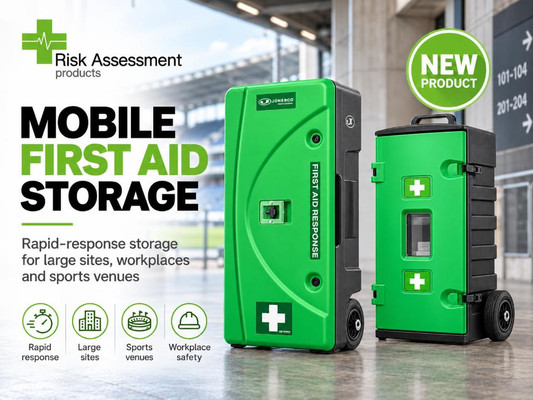
Mobile First Aid Storage: Wheeled First Aid Cabinets for Large Workplaces
When an emergency happens, first aid equipment needs to be accessible, wherever the incident occurs.
In a small workplace, a fixed first aid cabinet may be enough.
But warehouses, construction sites, industrial facilities, schools, universities, sports venues and other large premises can present a very different challenge.
If an incident occurs hundreds of metres from the nearest first aid point, staff may need to leave the casualty, retrieve equipment and then carry multiple supplies back to the scene.
A mobile first aid response box provides another option: instead of bringing individual supplies to the emergency, responders can bring an organised first aid storage station directly to where it is needed.
Risk Assessment Products supplies mobile first aid storage designed for larger workplaces and emergency-response environments.
What Is Mobile First Aid Storage?
Mobile first aid storage is a wheeled cabinet or response box designed to hold and transport first aid and emergency-response equipment around a workplace or site.
Unlike a fixed wall-mounted cabinet, a mobile response box can be moved between locations as operational needs change.
Depending on the equipment stored inside, this can allow responders to transport:
- workplace first aid kits;
- trauma dressings;
- bleed control equipment;
- burns supplies;
- eyewash products;
- PPE;
- biohazard equipment;
- emergency blankets;
- first aid consumables; and
- other site-specific emergency supplies.
The storage equipment itself does not determine what should be carried. The contents should reflect the organisation's first aid needs assessment.
Why Can Mobile First Aid Storage Be Useful?
HSE requires employers to provide first aid arrangements that are adequate and appropriate for their circumstances.
That assessment should consider the workplace, workforce, hazards and risks, as well as issues such as remote workers, workforce distribution, distance from emergency medical services and first aid provision for members of the public.
HSE also states that while every workplace should have at least one first aid kit, larger sites may require more than one, and first aid equipment should be easily accessible. HSE
That makes accessibility particularly important on large or complex sites.
Imagine an incident occurring:
- at the far end of a distribution warehouse;
- on a remote section of a construction project;
- in another building on a school campus;
- beside an outdoor sports area;
- within a manufacturing facility;
- at a transport depot;
- across a large public venue.
A fixed first aid point may remain essential, but a mobile response unit can provide an additional way to bring larger quantities of emergency equipment closer to the casualty.
Introducing the Wheeled First Aid Response Box Range
Risk Assessment Products currently offers two main mobile first aid storage options:
- 100F Wheeled First Aid Response Box
- 95M Wheeled First Aid Response Box
Both provide substantial mobile storage, but they are designed around slightly different priorities.
100F Wheeled First Aid Response Box - Mobile First Aid Cabinet
The 100F Mobile First Aid Cabinet is designed for demanding workplaces requiring robust, protected emergency storage.
The enclosure is manufactured from UV-stabilised roto-moulded polyethylene and is designed to resist impact and corrosion.
Key features include:
- IP56-rated enclosure to BS EN 60529
- UV-stabilised polyethylene construction
- 160 mm integrated wheels
- built-in handles
- foot grip for easier manoeuvring
- tamper-resistant locking arrangement
- break-glass emergency key access
- freestanding or wall-mounted installation
- generous internal storage space.
Dimensions: 1000 mm high x 450 mm wide x 320 mm deep.
Where might the 100F be most suitable?
The 100F is particularly relevant where equipment may need additional environmental protection or security.
Potential settings include:
- construction sites;
- manufacturing facilities;
- distribution warehouses;
- transport depots;
- engineering sites;
- industrial workplaces;
- utilities operations.
View the 100F Mobile First Aid Cabinet
95M Wheeled First Aid Response Box - Mobile First Aid Storage
The 95M Wheeled First Aid Response Box takes a slightly different approach.
Its design focuses strongly on visibility, internal organisation and ease of access.
Features include:
- UV-stabilised polyethylene construction
- UV-blocking polycarbonate viewing window
- 200 mm solid synthetic rubber wheels
- removable internal shelf
- internal buckle and webbing securing strap
- protective door seal
- twin toggle latches with split pins
- high-visibility first aid design.
The window allows responsible staff to inspect stored equipment without necessarily opening the cabinet.
Its removable shelf and internal securing strap also make it useful where several types of emergency equipment need to be kept organised.
Dimensions: 1000 mm high × 540 mm wide × 345 mm deep.
Where might the 95M be most suitable?
Possible environments include:
- schools;
- universities;
- leisure centres;
- sports venues;
- event locations;
- warehouses;
- public-access facilities;
- large commercial premises.
View the 95M Wheeled First Aid Response Box
100F vs 95M: Which Mobile First Aid Cabinet Should You Choose?
| Feature | 100F Mobile First Aid Cabinet | 95M Mobile First Aid Storage |
| Best suited to | Industrial, construction and demanding environments. | Schools, venues, leisure and general large-site use |
| Dimensions | 1000x450x320mm | 1000x540x345mm |
| Wheels | 160mm | 200mm |
| Viewing window | No | Yes |
| Removable shelf | No | Yes |
| Internal securing strap | No | Yes |
| IP Rating | IP56 | |
| Security | Tamper-resistant lock with break-glass emergency access | Toggle latches with split pins |
| Installation | Freestanding or wall mounted | Primarily mobile |
| Main strength | Protection and secure storage | Organisation and visible contents |
The choice therefore depends less on which unit is "better" and more on where it will be used and what needs to be stored inside.
What Should You Store in a Mobile First Aid Cabinet?
The contents should come from the organisation's first aid needs assessment rather than from a generic list.
HSE says first aid provision should reflect factors such as:
- the nature of the work;
- workplace hazards;
- workforce size;
- work patterns;
- accident history;
- remote or lone workers;
- distribution of the workforce;
- proximity to emergency medical services; and
- whether non-employees may require first aid.
That means a school, warehouse and construction site may all need very different contents.
Workplace First Aid Kits
A standard workplace first aid kit provides supplies for common injuries and should normally form part of wider workplace first aid arrangements.
The quantity and contents should reflect the first aid needs assessment.
This is one of the most natural products to purchase alongside a mobile response box.
Bleed Control & Trauma Equipment
Some workplaces or public venues may identify a need for specialist equipment for severe bleeding.
This may be particularly relevant to environments involving:
- machinery;
- sharp tools;
- construction work;
- manufacturing;
- public-access venues;
- higher-risk operations.
A mobile response cabinet can provide space for appropriate trauma supplies where they have been identified as part of the organisation's risk and first aid planning.
Explore Bleed Control & Trauma Equipment
Potential equipment may include trauma dressings, tourniquets and specialist bleed-control kits where appropriate
Eyewash Equipment
Sites involving dust, particulates, chemicals or other eye hazards may also require suitable eyewash provision.
Portable eyewash products may form part of a mobile response arrangement where the first aid needs assessment identifies the requirement.
Browse Eyewash Stations & Equipment
Burns First Aid
Workplaces involving:
- hot machinery;
- hot liquids;
- welding;
- electrical work;
- kitchens;
- manufacturing processes;
may identify a need for dedicated burns supplies.
Where the risk assessment supports it, burns products can be stored alongside other first aid equipment in a larger mobile response unit.
PPE and Responder Equipment
Depending on the application, useful supporting equipment may include:
disposable gloves;
face protection;
aprons;
CPR barriers;
scissors;
waste bags;
cleaning supplies.
These should again be selected according to the risks and procedures of the site.
Can a Mobile First Aid Cabinet Replace Fixed First Aid Provision?
Not necessarily.
For many sites, mobile first aid storage works best alongside fixed first aid points rather than replacing them.
For example, a large warehouse might have:
- a main first aid room;
- fixed first aid kits at key locations;
- a mobile first aid response box for incidents further across the site.
Similarly, a school campus might maintain first aid supplies in the main office while also using a mobile response unit for sports areas, outdoor events or buildings further away.
The objective is to make emergency equipment accessible without creating unnecessary delays.
Are the Mobile Response Boxes Supplied Stocked?
No. The 100F and 95M products are first aid storage units.
First aid kits, bleed-control equipment, eyewash supplies and other medical consumables must be selected and purchased separately.
This gives organisations flexibility to stock the cabinet according to their actual needs rather than receiving a fixed generic contents package.
Mobile First Aid Storage for Warehouses
Warehouses are particularly well suited to mobile emergency storage because they can cover substantial floor areas.
Potential challenges include:
- long walking distances;
- racking restricting direct routes;
- separate loading bays;
- mezzanine floors;
- yard areas;
- moving plant and vehicles.
HSE specifically advises employers to consider workforce distribution and requires first aid equipment to be easily accessible.
A mobile response box could therefore complement strategically positioned fixed first aid kits.
Mobile First Aid Storage for Construction Sites
Construction projects create another clear use case.
Work locations can change as the project progresses, making purely fixed first aid arrangements less flexible.
A wheeled cabinet can allow an appointed responder or first aid team to relocate larger quantities of equipment as site activity moves.
The 100F is particularly relevant because of its robust construction, IP56-rated enclosure and secure access arrangement.
However, construction employers must still ensure that their wider first aid arrangements remain adequate for the site and workforce.
Mobile First Aid Storage for Schools and Universities
Educational campuses can include:
- ultiple buildings;
- workshops;
- sports halls;
- playing fields;
- science departments;
- performance spaces;
- outdoor areas.
A 95M response box could be particularly useful where first aid resources need to move between these different environments.
The visible window also makes stock checks easier.
Mobile First Aid Storage for Sports and Leisure Facilities
Sports venues can present additional challenges because incidents may happen some distance from reception or a fixed treatment room.
A mobile cabinet can provide space for:
- routine first aid products;
- trauma dressings;
- cold packs;
- PPE;
- specialist emergency equipment identified by the venue.
This may be useful in leisure centres, sports grounds, athletics facilities and large community venues.
Mobile First Aid Storage for Public Venues
Large public-facing premises may also benefit from reviewing how emergency equipment is distributed.
Potential settings include:
- exhibition centres;
- entertainment venues;
- visitor attractions;
- transport facilities;
- large hospitality sites.
Where many people may be present, emergency preparedness should consider not just what equipment exists but how quickly trained responders can actually access and deploy it.
What About Martyn's Law?
The Terrorism (Protection of Premises) Act 2025, commonly referred to as Martyn's Law, introduces new protective-security requirements for qualifying premises and events.
However, its substantive duties are not yet in force. The Home Office says there is no legal requirement to comply until commencement, and that the implementation period is at least 24 months from Royal Assent.
Mobile first aid storage is also not specifically mandated by Martyn's Law.
That said, organisations reviewing wider emergency-response and protective-security arrangements may reasonably consider whether emergency medical equipment can be deployed effectively throughout the premises.
The important point is to avoid presenting a mobile cabinet as a Martyn's Law compliance product in itself.
How Should Mobile First Aid Equipment Be Managed?
A response cabinet still needs ongoing management.
Responsibility should be assigned for:
- checking contents;
- monitoring expiry dates;
- replacing items after use;
- checking cabinet condition;
- confirming equipment remains accessible;
- ensuring staff know where the unit is stored;
- keeping wheels, locks and latches operational.
HSE recommends checking first aid kits regularly and replacing expired or used contents promptly. HSE
Can the Response Box Be Left Empty Until Needed?
That would defeat much of its purpose.
A mobile first aid cabinet is most useful when it is:
- appropriately stocked;
- organised;
- easy to identify;
- ready to deploy.
Organisations should therefore decide in advance which supplies belong inside and who is responsible for maintaining them.
Where Should a Mobile First Aid Cabinet Be Stored?
A mobile unit still needs a defined home location.
It should be:
- easy for responders to locate;
- accessible;
- clearly identified;
- not blocked by equipment;
- positioned where it can be moved quickly.
For very large sites, it may make sense to locate several fixed or mobile first aid resources rather than relying on one centrally stored unit.
Frequently Asked Questions
What is a wheeled first aid cabinet?
A wheeled first aid cabinet is a mobile storage unit designed to transport first aid and emergency-response equipment around larger workplaces and sites.
Are mobile first aid cabinets a legal requirement?
No.
UK employers must provide adequate and appropriate first aid arrangements based on their first aid needs assessment. A mobile cabinet may be one way of supporting those arrangements where the workplace layout or workforce distribution makes it useful.
Does HSE require more than one first aid kit on large sites?
HSE states that at least one first aid kit should be provided for each workplace and that more than one may be required on larger sites.
Which mobile first aid cabinet is better for construction?
The 100F may be particularly suitable for demanding environments because it provides an IP56-rated enclosure, robust polyethylene construction and secure emergency access.
Which mobile first aid cabinet is better for schools or venues?
The 95M may be particularly useful where visibility and organisation are important, because it includes a viewing window, removable shelf, securing strap and larger wheels.
Are first aid supplies included?
No. The current 100F and 95M models are supplied as storage units.
Can I store bleed-control equipment inside?
Yes, provided it forms part of the site's appropriate emergency-response arrangements and the cabinet has sufficient capacity.
Can I store eyewash supplies inside?
Yes. Portable eyewash products can be incorporated where the first aid needs assessment identifies an eye-injury risk.
Can mobile first aid storage replace a first aid room?
Not automatically.
Where a first aid needs assessment identifies the need for a dedicated first aid room, a mobile cabinet would not remove that requirement. HSE says first aid rooms are usually necessary in larger premises or where higher hazards are present when identified by the assessment.
Does Martyn's Law require mobile first aid equipment?
No. The Act does not specifically require wheeled first aid cabinets, and its substantive duties have not yet commenced.
Build a More Complete Mobile Emergency Response Setup
Mobile first aid storage is most valuable when it forms part of a wider emergency-response system.
Risk Assessment Products supplies equipment to help organisations build that system, including:
- Mobile First Aid Storage
- First Aid Kits
- Bleed Control & Trauma Equipment
- Eyewash Stations
- First Aid Trolleys
- First Aid Stations
- Emergency Response Equipment
Bring First Aid Equipment Closer to the Emergency
Effective first aid provision is not just about owning the correct equipment.
It is also about making sure that equipment is:
accessible, organised, maintained and available where it is needed.
For large workplaces, construction sites, warehouses, schools, universities, sports venues and public facilities, wheeled first aid storage can provide a practical additional way to deploy emergency equipment.
Compare the Range
Or view the individual products:
100F Wheeled First Aid Response Box
95M Wheeled First Aid Response Box
For help choosing suitable first aid and emergency-response equipment, contact us here
Recent Posts
-
Mobile First Aid Storage: Wheeled First Aid Cabinets for Large Workplaces
When an emergency happens, first aid equipment needs to be accessible, wherever the incident occurs. …8th Oct 2026 -
LUCAS 3 Mechanical CPR: When Every Compression Counts
During cardiac arrest, high-quality chest compressions with minimal interruptions are essential. But …2nd Oct 2026 -
BS 8599-1:2019+A1:2026: What the New Workplace AED Guidance Means
BS 8599-1:2019+A1:2026: What the New Workplace AED Guidance Means for UK EmployersThe British Standa …25th Sep 2026