
Is One Defibrillator Enough? AED Coverage for Large UK Workplaces
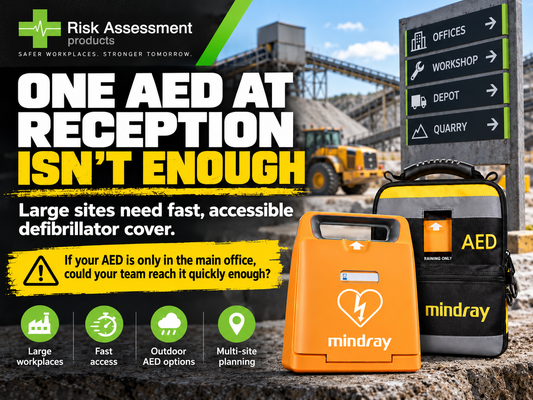
Having a defibrillator on site is an important step towards workplace emergency preparedness. But what happens if someone suffers a cardiac arrest hundreds of metres away from it?
For businesses operating quarries, aggregates facilities, recycling centres, warehouses, construction sites, industrial depots and other large workplaces, AED accessibility can be just as important as AED ownership.
A defibrillator located in the main office may be convenient for administrative staff, but could it be retrieved quickly enough if someone collapses in a workshop, loading yard, processing area or remote section of the site?
For organisations managing several UK locations, the challenge can become even greater.
The question is not simply whether your business has a defibrillator. It is whether somebody can get that defibrillator to a casualty quickly enough.
How Quickly Should a Defibrillator Be Accessible?
The British Heart Foundation recommends that an AED should ideally be possible to fetch within four minutes:
- approximately two minutes to reach the AED; and
- approximately two minutes to return to the casualty.
As a general guide, BHF suggests that the device should be within around 200 metres of where it may be needed when walking briskly.
This is an accessibility guide rather than a universal legal distance requirement.
And on many large workplaces, straight-line distance tells only part of the story.
Someone retrieving an AED may have to negotiate:
- security gates;
- separate buildings;
- stairs;
- vehicle routes;
- operating machinery;
- restricted areas;
- uneven ground;
- large storage areas;
- changing construction routes.
A defibrillator that appears close on a site plan can therefore take considerably longer to reach in practice.
Why Speed of Access Matters
Cardiac arrest is time-critical.
Resuscitation Council UK advises that an AED should be used as soon as it is available and that AED locations should be clearly signposted and easy to access. Current 2025 basic life support guidance also recommends that public-access AEDs should ideally be accessible 24 hours a day, seven days a week.
Resuscitation Council UK
Someone at the scene should call 999 and begin CPR immediately while another person retrieves the AED.
The aim is therefore not to place an AED somewhere that is simply convenient to store.
It should be placed where it can realistically reach the casualty quickly.
Does BS 8599-1:2019+A1:2026 Change Workplace AED Planning?
The 2026 amendment to BS 8599-1 is significant because the British Standard now explicitly covers:
“Contents of first aid kits and provision of Automated External Defibrillators (AEDs) in the workplace.”
This does not create a blanket legal requirement for every workplace to install a defibrillator.
HSE guidance still places workplace first-aid provision within the employer's first-aid needs assessment.
Where an employer decides to provide an AED following that assessment, HSE says the equipment should be appropriately managed and information or instructions supplied for its use.
The practical implication is that employers now have an even stronger reason to review:
- whether AED provision is appropriate;
- how many AEDs may be required;
- where they are located;
- whether they are readily accessible;
- how they are stored;
- how they are checked and maintained.
For a detailed explanation, read:
BS 8599-1:2019+A1:2026: What the New Workplace AED Guidance Means
Why Large Sites May Need More Than One AED
There is no universal rule saying that a workplace of a particular size must have a specific number of defibrillators.
Instead, the practical question is:
Can an AED be retrieved quickly from every area where people may be working?
This becomes particularly important on large operational sites.
A quarry, warehouse or industrial facility may contain:
- offices and reception;
- weighbridges;
- workshops;
- production areas;
- loading bays;
- yards;
- extraction or processing areas;
- welfare facilities;
- separate buildings;
- remote work zones.
One AED positioned beside reception may provide good coverage for the office but poor coverage for the furthest operational area.
In those circumstances, additional strategically positioned AEDs may reduce retrieval time significantly.
Quarries and Aggregates Sites
Quarries and aggregates facilities can cover very large geographical areas.
Workers may be based around:
- extraction areas;
- crushing and screening equipment;
- workshops;
- loading zones;
- weighbridges;
- mobile plant;
- welfare facilities.
Terrain, vehicle movement and access controls can all affect how quickly someone can retrieve emergency equipment.
An AED provision review might therefore consider several potential locations rather than automatically placing a single device in the main office.
Earthworks and Construction Sites
Construction sites present a different challenge because their layout changes.
As projects progress:
- welfare facilities may move;
- access routes change;
- teams relocate;
- buildings become inaccessible;
- working areas expand.
An AED location that provided good coverage at the start of a project may be less suitable several months later.
This means AED accessibility should be reviewed as the site evolves.
Warehouses and Distribution Centres
Large warehouses can contain:
- extensive racking;
- multiple loading bays;
- mezzanine floors;
- large yards;
- separate offices;
- secure zones.
An AED in reception may be several minutes away from someone working at the opposite end of the building.
Warehouse operators should therefore consider realistic walking routes and access barriers rather than relying on straight-line distances.
Recycling and Waste Facilities
Recycling and waste operations may include large processing yards, vehicle traffic and machinery areas.
Staff can be dispersed across several operational zones.
Where one centrally positioned AED creates long retrieval routes, further AED locations may be worth considering.
Multi-Site Businesses
Businesses operating multiple depots, quarries, warehouses or branches face another challenge.
Providing “one AED per site” may sound consistent but can actually produce very different levels of coverage.
A small depot might be adequately served by one AED.
A larger quarry or distribution centre may require several.
That is why each location should be assessed individually even when AED purchasing is managed centrally.
How Many Defibrillators Does a Large Workplace Need?
There is no simple formula.
A useful assessment should consider:
Site size and layout
How long would it take to reach an AED from the furthest regularly occupied location?
Real-world access
Consider barriers such as:
- locked doors;
- gates;
- lifts;
- stairs;
- operational vehicles;
- machinery;
- uneven terrain.
Workforce distribution
Where are people actually working throughout the day?
Shift patterns
- Can the AED still be accessed:
- overnight;
- at weekends;
- when reception is closed;
- when particular buildings are locked?
Separate buildings
A multi-building site may require different provision from a single open-plan facility.
Existing AEDs
Check:
- location;
- visibility;
- signage;
- accessibility;
- readiness.
Public access
If appropriate, could the AED also be made available to visitors or the wider community?
Changing site conditions
This is particularly important on construction and large infrastructure projects.
Don't Guess - Assess Your Site
Before buying additional AEDs, review your current coverage properly.
Risk Assessment Products provides a free Defibrillator Site Assessment Form designed to help organisations consider:
- site size;
- workforce and visitor numbers;
- existing AED provision;
- retrieval barriers;
- possible AED positions;
- indoor or outdoor storage;
- signage;
- accessibility;
- maintenance responsibilities.
Download the Free Defibrillator Site Assessment Form
This can be used for a single workplace or repeated across multiple sites to create a more consistent group-level review.
Choosing the Right AED for a Large Workplace
There is no need to limit the decision to one specific AED model.
The best device depends on the environment.
Useful factors to compare include:
- indoor or outdoor placement;
- IP rating;
- operating temperature;
- durability;
- ease of use;
- semi-automatic or fully automatic operation;
- adult and paediatric functionality;
- CPR feedback;
- pad lifespan;
- battery lifespan;
- size and portability;
- warranty and support.
Risk Assessment Products supplies AEDs from a range of manufacturers including ZOLL, i-PAD, Mindray, HeartSine, Philips, Schiller and others.
Rather than choosing purely by brand, it can be easier to start with the intended environment.
Fully Automatic or Semi-Automatic AED?
Both types analyse the casualty's heart rhythm automatically.
A semi-automatic AED advises when a shock is required and asks the rescuer to press the shock button.
A fully automatic AED warns rescuers to stand clear and then delivers the advised shock automatically.
Neither format is universally better.
For large organisations standardising equipment across several sites, consistency may be useful because staff moving between locations encounter the same operating method.
Outdoor AED Cabinets Can Improve Site Coverage
For many large sites, the best AED position may not be inside an office.
Placing an AED in a suitable outdoor cabinet can make it accessible closer to:
- workshops;
- yards;
- production areas;
- welfare areas;
- site entrances;
- sports facilities;
- remote buildings.
Depending on the AED and environment, outdoor cabinets may provide:
- weather protection;
- temperature management;
- increased visibility;
- easier access;
- mounting in operational areas rather than offices.
The cabinet must be compatible with the AED and suitable for the site conditions.
For public-access devices, current Resuscitation Council UK guidance recommends unlocked cabinets to avoid unnecessary delays.
Make the AED Easy to Find
An AED is less useful if staff cannot immediately locate it.
Clear signage should be part of the installation.
Resuscitation Council UK recommends prominent AED signage and says staff should know where the nearest device is located.
On large sites, it may also be useful to incorporate AED locations into:
site induction;
emergency procedures;
maps;
staff briefings;
first-aid documentation.
Standardising AEDs Across Multiple Sites
Centralising AED procurement can offer several operational advantages.
Using a smaller number of approved models can simplify:
- staff familiarisation;
- replacement pad purchasing;
- battery purchasing;
- record keeping;
- maintenance;
- signage;
- documentation.
However, standardising the AED model should not mean standardising the quantity.
Each site still needs its own accessibility assessment.
A business might therefore standardise on one or two AED models while purchasing:
one AED for smaller facilities;
multiple AEDs for larger sites;
outdoor cabinets where needed;
different storage arrangements according to environment.
Register Public-Access AEDs on The Circuit
Where an AED is available for public use, it should be registered on The Circuit, the UK's national defibrillator network.
Registration helps ambulance services know:
where the AED is;
when it is available;
whether it is emergency ready.
Resuscitation Council UK strongly encourages registration and maintaining accurate readiness information.
For large companies, The Circuit can also form part of a wider AED-management process.
Maintaining Multiple Workplace AEDs
Installing additional AEDs increases the importance of good management.
Each device should have a clearly assigned person or team responsible for checking:
- readiness indicator;
- electrode pads;
- pad expiry dates;
- battery status;
- cabinet condition;
- signage;
- accessibility;
- rescue accessories.
Risk Assessment Products provides a free AED Weekly Inspection Record to help organisations document routine checks.
Download the Free AED Weekly Inspection Record
Replacement Pads and Batteries
AEDs are low-maintenance devices, but consumables still need managing.
Electrode pads normally have an expiry date and must also be replaced following use.
Battery life varies by manufacturer and model.
For businesses operating multiple AEDs, standardising devices can simplify future consumable purchasing.
Are Defibrillators a Legal Requirement in UK Workplaces?
There is no general UK law requiring every employer to install an AED.
Resuscitation Council UK confirms that there is no general statutory requirement for employers to provide one, although an AED can appropriately form part of a workplace first-aid needs assessment.
HSE guidance requires employers to determine appropriate first-aid provision according to their workplace circumstances.
The 2026 amendment to BS 8599-1 now gives workplace AED provision greater prominence within recognised British first-aid standards, but the standard itself is not legislation.
For large, remote or dispersed workplaces, documenting that AED provision has been considered is therefore increasingly sensible.
What Should You Do if Someone Has a Cardiac Arrest?
If somebody is unresponsive and not breathing normally:
1. Call 999.
2. Start CPR immediately.
3. Send somebody to retrieve the nearest AED.
4. Switch the AED on when it arrives.
5. Attach the pads as shown.
6. Follow the AED's spoken and visual instructions.
7. Continue CPR when instructed.
Do not wait for the AED before starting CPR.
Current Resuscitation Council UK guidance says to start chest compressions as soon as possible and use an AED as soon as it becomes available.
Frequently Asked Questions
Is one defibrillator enough for a large workplace?
Not necessarily.
The appropriate number depends on realistic retrieval times, site layout, workforce distribution and barriers to access.
How far away should an AED be?
BHF recommends that an AED should ideally be possible to retrieve within four minutes - around two minutes to reach it and two minutes to return. Approximately 200 metres is given as a general brisk-walking guide.
Does every building need its own AED?
Not automatically.
Assess whether an existing AED can be brought to the casualty sufficiently quickly.
Should a quarry have more than one AED?
Potentially.
A large quarry may have separate offices, processing facilities, workshops and extraction areas. Practical retrieval time should determine whether additional AED locations are appropriate.
Can AEDs be stored outside?
Yes, provided the AED is protected appropriately and the installation follows the manufacturer's operating requirements.
Should outdoor AED cabinets be locked?
For public-access AEDs, Resuscitation Council UK recommends unlocked cabinets because they remove delays in emergency access.
Should public-access workplace AEDs be registered?
Yes.
Register them on The Circuit so ambulance services can locate them during emergencies.
Is there a legal requirement to have an AED at work?
There is no general UK statutory requirement for all workplaces to have an AED. Employers should determine appropriate provision through their first-aid needs assessment.
Does BS 8599-1:2019+A1:2026 mean workplaces must buy AEDs?
Not as a blanket legal requirement.
The amendment explicitly addresses workplace AED provision, making it an important best-practice consideration, but a British Standard is not itself legislation.
Review Your Workplace AED Coverage
For large workplaces, the question should not simply be:
“Do we have a defibrillator?”
It should be:
“Can someone get an AED to a casualty quickly from every important area of this site?”
Risk Assessment Products can help organisations plan and maintain workplace AED provision with:
Defibrillator Machines
Shop AEDs by Setting
AED Cabinets & Cases
AED Signs & Posters
Defibrillator Pads
Defibrillator Batteries
Free AED Site Assessment Form
Free AED Weekly Inspection Record
For organisations operating several sites, RAP can also help identify suitable AED models, cabinets and supporting equipment for a more consistent purchasing approach.
Contact Risk Assessment Products with your enquiry here.
Recent Posts
-
Is One Defibrillator Enough? AED Coverage for Large UK Workplaces
Having a defibrillator on site is an important step towards workplace emergency preparedness. But wh …16th Oct 2026 -
Mobile First Aid Storage: Wheeled First Aid Cabinets for Large Workplaces
When an emergency happens, first aid equipment needs to be accessible, wherever the incident occurs. …8th Oct 2026 -
LUCAS 3 Mechanical CPR: When Every Compression Counts
During cardiac arrest, high-quality chest compressions with minimal interruptions are essential. But …2nd Oct 2026