
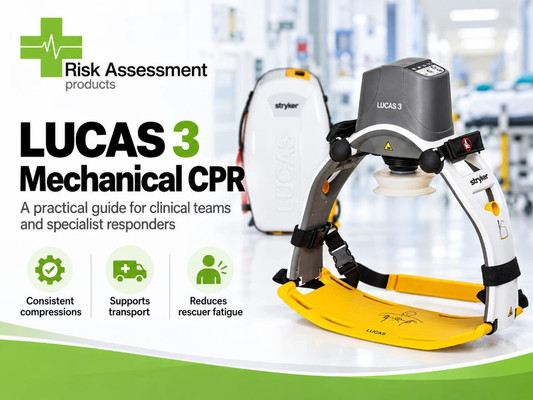
LUCAS 3 Mechanical CPR: When Every Compression Counts
During cardiac arrest, high-quality chest compressions with minimal interruptions are essential. But what happens when a patient needs transporting, treatment becomes prolonged or performing manual CPR becomes difficult or unsafe?
For ambulance crews, hospital resuscitation teams and specialist emergency responders, these situations present significant practical challenges.
The LUCAS 3.1 CPR Chest Compression System, manufactured by Stryker, is designed to help trained healthcare professionals deliver consistent mechanical chest compressions in selected resuscitation circumstances.
The device can support resuscitation during patient movement, specialist interventions and other situations where delivering high-quality manual CPR is impractical or may compromise rescuer safety.
However, mechanical CPR is not recommended as a routine replacement for manual CPR, and organisations need to consider clinical suitability, training, equipment readiness and operational requirements before investing.
So, how does the LUCAS 3.1 work, where can it be useful and what should healthcare organisations consider when choosing a mechanical CPR system?
What Is the LUCAS 3 CPR Chest Compression System?
The LUCAS 3.1 is a portable, battery-powered mechanical chest compression device designed for use by trained healthcare professionals during cardiac arrest.
Instead of requiring a rescuer to perform every chest compression manually, LUCAS uses a motor-driven piston with a suction cup positioned over the patient's chest.
Once correctly fitted and activated, the device delivers chest compressions at a consistent, configured rate and depth.
The system can be used in selected circumstances where conventional manual compressions are difficult to maintain or create additional safety risks.
Typical environments include:
- Ambulance and pre-hospital emergency services
- Hospital emergency departments
- Cardiac catheterisation laboratories
- Critical care and specialist patient transfers
- Appropriately trained specialist emergency-response teams.
The LUCAS 3.1 does not replace clinical assessment, trained resuscitation personnel, defibrillation or other advanced life support treatments.
View the LUCAS 3.1 CPR Chest Compression System
Why Is Maintaining High-Quality CPR Challenging?
Chest compressions are physically demanding, particularly during prolonged resuscitation.
Clinical teams must deliver appropriate compression depth, rate and recoil while limiting interruptions and managing other essential treatments.
Several situations can make this difficult.
1. Rescuer Fatigue During Prolonged CPR
Repeated manual compressions require considerable physical effort.
During prolonged resuscitation, fatigue can affect the quality and consistency of compressions.
Clinical teams normally rotate rescuers performing compressions, aiming to keep interruptions as short as possible.
Where mechanical CPR is clinically appropriate, LUCAS can reduce the physical burden of repeated manual compressions.
2. CPR During Ambulance Transport
Delivering effective manual chest compressions inside a moving ambulance can be challenging.
Personnel attempting compressions may be unable to remain safely seated and restrained, potentially exposing them to additional risks.
For selected patients, mechanical chest compressions can provide an alternative where manual CPR cannot be delivered safely or effectively during transport.
Deployment must still follow local clinical protocols and transport arrangements.
3. Complex Hospital Procedures
Some patients require specialist treatment while resuscitation continues.
For example, in a cardiac catheterisation laboratory, manual chest compressions may interfere with clinical procedures or expose staff to additional risks during imaging.
Mechanical CPR may help maintain compressions while allowing clinicians to perform necessary investigations or interventions in appropriate circumstances.
4. Limited Personnel and Competing Clinical Tasks
Resuscitation teams must coordinate several interventions, including:
- Airway management and ventilation
- Defibrillation
- Medication administration
- Monitoring and rhythm assessment
- Identifying and treating reversible causes
- Preparing for specialist interventions
Where manual compression delivery becomes impractical, mechanical CPR may provide additional operational capability.
The purpose is to support clinically appropriate resuscitation, not eliminate the need for trained personnel.
Five Features of the LUCAS 3.1 Mechanical CPR System
1. Consistent Chest Compressions
The LUCAS 3.1 provides automated compressions using controlled mechanical settings.
The device offers configurable rates of:
- 102 compressions per minute
- 111 compressions per minute
- 120 compressions per minute
Compression depth can be configured between 45 mm and 53 mm, with actual operating depth dependent on patient chest dimensions and the manufacturer's specifications.
This allows authorised clinical teams to use consistent device settings within approved operating protocols.
2. Support During Patient Movement
Moving or transporting a patient in cardiac arrest can make manual CPR difficult.
In appropriately selected circumstances, LUCAS can maintain mechanical compressions during movement or transport.
This may be relevant during transfers to specialist departments or facilities where further treatment is planned.
3. Reduced Physical Demands on Rescuers
Automated compressions reduce the need for continuous manual compression delivery while the device is operating.
This can be useful during prolonged or technically demanding resuscitations.
However, clinical teams must continue to supervise the patient, assess treatment effectiveness and manage all other aspects of resuscitation.
4. Configurable Operating Settings
LUCAS 3.1 incorporates several configurable features, including:
- Compression rate and depth
- Compression and ventilation settings
- Adjustable ventilation pauses
- Compression cycle options
- AutoFit and QuickFit piston-positioning functions
- An audible CPR timer
- Optional pressure pad release
- Configuration changes must be made by appropriately authorised personnel following the manufacturer's instructions and local clinical procedures.
5. Connectivity and Post-Event Review
The device supports Wi-Fi connectivity and compatible data-management functions.
Depending on the organisation's configuration and available systems, these may include integration with Stryker's LIFENET and CODE-STAT services.
Post-event data can support clinical review, equipment management and resuscitation quality-improvement processes.
LUCAS 3.1 vs Manual CPR: When Is Mechanical CPR Appropriate?
Mechanical CPR is not routinely recommended in preference to high-quality manual chest compressions.
Resuscitation Council UK's 2025 Adult Advanced Life Support Guidelines recommend considering mechanical chest compressions only when:
- High-quality manual chest compressions are impractical; or
- Manual compressions would compromise the safety of the rescuer.
The guidelines also emphasise the importance of minimising interruptions during device application and ensuring that deployment is carried out by trained teams familiar with the equipment.
This distinction is important when evaluating LUCAS 3.1.
The strongest justification for using mechanical CPR lies in identified clinical or operational challenges, rather than assuming automated compressions are always superior.
Does Mechanical CPR Improve Survival Rates?
Mechanical CPR devices can deliver consistent compressions, but this does not mean they have been proven to improve survival when used routinely instead of manual CPR.
The UK PARAMEDIC trial assessed the earlier LUCAS 2 mechanical CPR device in out-of-hospital cardiac arrest.
It found no evidence of improved 30-day survival compared with conventional manual chest compressions.
Other randomised research has similarly not established a general survival benefit from routine mechanical CPR use.
These findings do not remove the potential operational value of mechanical CPR in selected circumstances.
Instead, they reinforce the need to match device use to clinical requirements, professional judgement and current resuscitation guidance.
For NHS procurement teams and healthcare organisations, LUCAS should therefore be considered as a specialist capability rather than a universal replacement for manual CPR.
Where Can LUCAS 3.1 Be Particularly Useful?
Ambulance and Pre-Hospital Emergency Services
In selected transport situations, mechanical CPR can reduce the need for personnel to perform manual compressions in a moving vehicle.
This may help teams manage staff safety while maintaining resuscitation efforts during transfer.
Hospital Emergency Departments
Emergency departments may encounter complex or prolonged resuscitations where manual compression delivery becomes difficult.
Mechanical CPR may be considered where appropriate under local protocols.
Cardiac Catheterisation Laboratories
During selected cardiac procedures, mechanical compressions may allow clinicians to continue treatment while reducing interruptions or difficulties associated with manual compressions.
Critical Care and Specialist Transfers
Selected patients may require transfer to advanced cardiac treatment, including facilities providing extracorporeal CPR (ECPR).
Mechanical compressions may support these carefully planned transfers where clinically indicated.
Specialist Emergency-Response Organisations
Appropriately trained teams operating in challenging environments may consider mechanical CPR where high-quality manual compressions cannot be safely or practically maintained.
In every setting, patient eligibility, device positioning, training and local clinical governance remain essential.
LUCAS 3.1: Key Technical Specifications
- Manufacturer: Stryker
- Device: LUCAS 3, version 3.1
- Device type: Mechanical chest compression system
- Compression mechanism: Motor-driven piston with suction cup
- Compression rate: Configurable to 102, 111 or 120 per minute
- Compression depth: Configurable 45–53 mm, subject to patient dimensions
- Power: Rechargeable battery or compatible external supply
- Battery operation: Typically around 45 minutes per fully charged battery
- Ventilation support: Configurable alerts and pause settings
- Positioning: AutoFit and QuickFit functions
- Connectivity: Wi-Fi and compatible reporting systems
- Intended operators: Appropriately trained professionals.
Actual settings, operating limits, patient suitability and battery performance must be checked against the relevant manufacturer's instructions for use.
What Is Included with the LUCAS 3.1 System?
The LUCAS 3.1 system supplied by Risk Assessment Products, Stryker part number 99576-000065, includes:
- 1 x LUCAS 3.1 Chest Compression System
- 1 x Rechargeable battery
- 1 x Hard shell carrying case
- 1 x Stabilisation strap
- 1 x Patient wrist straps
- 2 x Disposable suction cups
- Instructions for use
The system is supplied with the principal components for operation.
However, the external power supply is a separately purchased accessory, and organisations should consider whether additional equipment is appropriate for their intended use.
What Else Should You Buy with a LUCAS 3.1 CPR System?
For ambulance services, NHS departments and specialist emergency-response organisations, the initial device purchase is only part of the procurement decision.
Operational readiness also depends on power arrangements, available consumables, storage, inspection and maintenance.
LUCAS 3 Replacement Batteries
The standard system includes one rechargeable battery.
An additional battery may be useful for:
- Prolonged resuscitation incidents
- Battery rotation
- Consecutive deployments
- Operations involving several vehicles or departments
- Maintaining equipment availability between incidents
According to Stryker, a fully charged battery typically provides approximately 45 minutes of operation, subject to operating conditions.
Healthcare organisations should consider whether the standard battery provision is sufficient for their anticipated deployments.
Shop LUCAS Replacement Batteries
LUCAS 3.1 External Power Supply
The compatible LUCAS 3.1 power supply is intended to support external power operation and battery charging arrangements.
This may be particularly relevant for hospital departments, equipment stores and clinical teams managing extended device availability.
An appropriate charging and power-management process helps ensure the device is ready when required.
View the LUCAS 3.1 Chest Compression Power Supply
Replacement Suction Cups and Consumables
LUCAS 3.1 uses device-specific components that must be managed in accordance with the manufacturer's instructions.
Healthcare organisations should consider:
- Availability of approved replacement suction cups
- Replacement intervals
- Inspection requirements
- Stock-control procedures
- Cleaning and infection-prevention arrangements
- Compatibility with the installed device version
Only manufacturer-approved compatible components should be used.
Hard Shell Carrying Case
The standard LUCAS 3.1 system already includes a hard shell carrying case.
However, replacement cases may be required where existing equipment has become damaged or unsuitable.
The carrying case is designed to provide protection during storage and transport and includes practical features for equipment management.
Mechanical CPR and Defibrillation: What Other Equipment Is Needed?
LUCAS provides chest compressions. It is not a defibrillator, and it does not independently assess or treat shockable cardiac arrest rhythms.
Advanced resuscitation may require:
- Rhythm assessment
- Defibrillation
- Airway and ventilation management
- Physiological monitoring
- Medication administration
- Treatment of reversible causes
The equipment used depends on the clinical environment and approved resuscitation protocols.
For example, appropriately trained advanced life support teams may use a manual defibrillator/monitor as part of their standard resuscitation equipment.
Public-access AEDs serve a different operating requirement and should not be assumed to replace specialist professional monitoring and defibrillation equipment.
Risk Assessment Products also supplies a range of Defibrillators & AEDs for relevant clinical, workplace and emergency-response requirements.
Airway Management and Supporting Resuscitation Equipment
Chest compressions are only one component of advanced life support.
Specialist resuscitation teams must also manage airway patency, ventilation and other clinical interventions.
Depending on the clinical environment, equipment may include:
- Airway-management devices
- Ventilation equipment
- Suction equipment
- Monitoring equipment
- Appropriate resuscitation consumables
Equipment requirements should be established through the organisation's clinical protocols and procurement arrangements.
Risk Assessment Products supplies suction devices as part of its wider medical and emergency-response equipment range.
LUCAS 3.1 Training and Familiarisation
Effective mechanical CPR requires more than familiarity with the control panel.
Personnel must understand when the device is clinically appropriate, how to apply it correctly and how to minimise interruptions to chest compressions.
Training programmes should cover:
Device Application
Correct patient assessment, positioning and fitting in accordance with the manufacturer's instructions.
Minimising Interruptions
Coordinating deployment so that interruption to chest compressions is kept as short as possible.
Team Coordination
Clear roles and communication between responders during installation, operation and removal.
Clinical Procedures
Integration with local advanced life support protocols, including defibrillation and ventilation.
Device Removal
Recognising circumstances in which the device needs repositioning, discontinuation or removal.
Post-Use Readiness
Cleaning, inspection, battery management and replacement of applicable consumables.
Training and competency arrangements must reflect the specific LUCAS model.
General CPR manikins should not be assumed to be compatible with mechanical chest compression devices without manufacturer confirmation.
Risk Assessment Products also supplies wider CPR training equipment for relevant training requirements.
How Should LUCAS 3.1 Be Checked and Maintained?
Like other critical resuscitation equipment, mechanical chest compression systems require routine readiness checks.
These should follow the manufacturer's instructions and the organisation's equipment-management procedures.
Areas to consider include:
- Battery charge and condition
- Power-supply arrangements
- Visible damage or wear
- Mechanical components
- Straps and accessories
- Availability of replacement suction cups
- Device cleanliness
- Fault indications
- Maintenance and servicing requirements
- Equipment readiness after deployment
Responsibilities should be clearly assigned so that the system is available and operational whenever it is required.
For larger organisations operating multiple LUCAS devices, consistent equipment checks and documented asset management can be particularly important.
LUCAS 3.1 Procurement Checklist
Before investing in a mechanical CPR system, procurement and clinical teams should review the complete operational requirement.
1. Intended Use
Will the system be deployed in an ambulance, emergency department, catheterisation laboratory or specialist transfer service?
2. Clinical Suitability
Are the intended situations consistent with Resuscitation Council UK guidance and locally approved procedures?
3. Patient Eligibility
Are staff trained to recognise patients who meet the manufacturer's criteria for device use?
4. Batteries and Power
Will additional batteries or external power equipment be needed?
5. Transport and Storage
How will the system be stored, protected and transported?
6. Replacement Consumables
How will approved replacement components be sourced and managed?
7. Training
Are appropriate initial and refresher training arrangements in place?
8. Maintenance
Who is responsible for routine checks, servicing and post-use readiness?
9. Clinical Governance
Are the required protocols, competency records and event-review arrangements established?
10. Total Cost of Ownership
Has the organisation considered the purchase price alongside accessories, training, replacement components and ongoing support?
The aim is to assess the system as part of the complete resuscitation capability rather than as a standalone device purchase.
Is the LUCAS 3.1 Worth the Investment?
The value of a mechanical chest compression system depends on the circumstances in which it will be used.
Where teams can consistently provide high-quality manual CPR without compromising staff safety, routine mechanical compression use has not been shown to provide a general survival advantage.
However, clinical services regularly dealing with difficult resuscitation environments may identify specific operational reasons to consider LUCAS 3.1.
Examples include:
- Resuscitation during selected patient transfers
- Challenging ambulance transport conditions
- Specialist catheterisation procedures
- Prolonged resuscitation where manual compressions become impractical
- Situations in which manual CPR exposes staff to additional risk
For these services, procurement decisions should be based on a documented clinical and operational assessment.
A properly planned purchase should also consider staff training, maintenance, approved accessories and readiness procedures.
Frequently Asked Questions
What is LUCAS 3.1 used for?
LUCAS 3.1 is a mechanical chest compression system used by trained professionals during selected cardiac arrest resuscitations, particularly where effective manual compressions are impractical or compromise rescuer safety.
Is mechanical CPR better than manual CPR?
Not routinely. Current UK guidelines do not recommend replacing high-quality manual CPR with mechanical CPR as standard practice.
Does LUCAS 3.1 improve survival?
Routine use of mechanical CPR has not been shown to provide a general survival advantage over high-quality manual CPR. Clinical studies involving the earlier LUCAS 2 system found no improvement in overall 30-day survival.
Can LUCAS 3.1 be used in an ambulance?
It may be used during selected ambulance transfers where clinically appropriate and where deployment follows relevant protocols, training and safety procedures.
How long does a LUCAS 3.1 battery last?
A fully charged battery typically provides approximately 45 minutes of operation. Actual performance varies with operating conditions and battery status.
Does LUCAS 3.1 require an external power supply?
The device can operate on its rechargeable battery. An external power supply is available separately to support compatible power and charging arrangements.
What comes with the LUCAS 3.1 system?
The standard RAP-listed package includes the device, one battery, hard shell carrying case, stabilisation strap, patient wrist straps, two disposable suction cups and instructions for use.
Does LUCAS 3.1 replace a defibrillator?
No. LUCAS provides mechanical chest compressions. Defibrillation, rhythm assessment and other advanced life support treatments remain separate clinical interventions.
Who can operate LUCAS 3.1?
It is intended for appropriately trained professionals familiar with the equipment, patient eligibility requirements and local resuscitation protocols.
What should organisations budget for?
In addition to the device, organisations should consider compatible spare batteries, external power arrangements, approved consumables, training, servicing and ongoing equipment management.
Buy the LUCAS 3.1 CPR Chest Compression System in the UK
Risk Assessment Products supplies specialist resuscitation and emergency-response equipment for healthcare organisations, ambulance services and trained professional responders.
Our LUCAS range includes the LUCAS 3.1 CPR Chest Compression System and supporting accessories to help organisations plan for appropriate deployment and operational readiness.
Explore the range:
LUCAS 3.1 CPR Chest Compression System
LUCAS Replacement Batteries and Accessories
LUCAS Hard Shell Carrying Case
Planning a clinical equipment purchase or reviewing your current mechanical CPR capability?
Contact Risk Assessment Products to discuss the available LUCAS equipment, compatible accessories and procurement requirements.
Contact Risk Assessment Products
Clinical information: LUCAS 3.1 is specialist medical equipment intended for trained professional use. This article provides general product and procurement information and does not replace the manufacturer's instructions, clinical assessment, current resuscitation guidelines or local procedures.
Recent Posts
-
LUCAS 3 Mechanical CPR: When Every Compression Counts
During cardiac arrest, high-quality chest compressions with minimal interruptions are essential. But …2nd Oct 2026 -
BS 8599-1:2019+A1:2026: What the New Workplace AED Guidance Means
BS 8599-1:2019+A1:2026: What the New Workplace AED Guidance Means for UK EmployersThe British Standa …25th Sep 2026 -
Choosing and Managing a Defibrillator Made Easier: Free AED Tools from Risk Assessment Products
Choosing a defibrillator is only one part of getting AED provision right. You also need to think abo …20th Sep 2026