
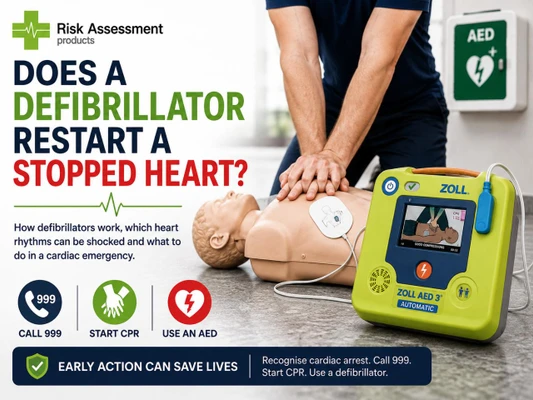
Does a defibrillator restart a stopped heart?
No, a defibrillator does not simply restart a completely stopped heart.
An automated external defibrillator (AED) analyses the electrical activity of the heart and delivers a shock only when it detects a heart rhythm that can benefit from defibrillation.
The shock is designed to interrupt certain dangerous abnormal electrical rhythms, giving the heart's normal electrical activity an opportunity to resume.
If someone is unresponsive and not breathing normally, call 999, start CPR and use an AED as soon as one is available.
What Does a Defibrillator Actually Do?
A defibrillator delivers a controlled electrical shock across the heart when it detects certain life-threatening heart rhythms.
During some cardiac arrests, the heart's electrical activity becomes chaotic and the heart can no longer pump blood effectively around the body.
A defibrillator does not act like a simple "restart button". Instead, defibrillation can interrupt the abnormal electrical activity so that an organised heart rhythm has an opportunity to return.
This is why early CPR and early defibrillation are both so important during a cardiac arrest.
What Is Cardiac Arrest?
A cardiac arrest occurs when the heart suddenly stops pumping blood effectively around the body.
The person will typically:
- become unresponsive;
- collapse; and
- not be breathing normally.
Cardiac arrest is a medical emergency.
Current Resuscitation Council UK guidance says that if you find someone who is unresponsive, you should call 999 as soon as possible. If they are unresponsive and not breathing normally, assume cardiac arrest and begin chest compressions.
An AED should be used as soon as one is available.
Can a Defibrillator Shock a Flatline?
No.
A "flatline" is commonly used to describe asystole, where there is no meaningful electrical activity in the heart.
Asystole is a non-shockable cardiac arrest rhythm.
An AED analyses the heart's electrical activity automatically. If the device identifies a non-shockable rhythm, it will not advise or deliver a shock.
Instead, rescuers should continue CPR and follow the instructions given by the AED and ambulance service.
Which Heart Rhythms Can a Defibrillator Shock?
The two main shockable cardiac arrest rhythms are:
- ventricular fibrillation (VF); and
- pulseless ventricular tachycardia (pVT).
Ventricular Fibrillation
Ventricular fibrillation occurs when the electrical activity in the ventricles becomes chaotic.
Instead of pumping blood effectively, the heart muscle quivers.
Defibrillation can interrupt this abnormal electrical activity and give the heart an opportunity to return to an organised rhythm.
Pulseless Ventricular Tachycardia
Pulseless ventricular tachycardia occurs when the ventricles contract extremely quickly but do not produce effective circulation.
This is also a shockable cardiac arrest rhythm.
The important point for the rescuer is that you do not need to identify the rhythm yourself.
The AED analyses the casualty's heart and decides whether a shock is appropriate.
What Heart Rhythms Cannot Be Shocked?
Two important non-shockable cardiac arrest rhythms are:
- asystole; and
- pulseless electrical activity (PEA).
An AED will not recommend a shock when it identifies a non-shockable rhythm.
If the AED says "no shock advised", immediately continue CPR and keep following the instructions from the AED.
When Should You Use a Defibrillator?
An AED should be used when someone is:
- unresponsive; and
- not breathing normally.
Do not wait to establish exactly why the person has collapsed.
Call 999, start CPR and get an AED as quickly as possible.
If another rescuer is available, one person can continue CPR while the other retrieves and prepares the AED.
What Should You Do If Someone Is in Cardiac Arrest?
If someone appears to be in cardiac arrest:
1. Check
Make sure it is safe to approach and check whether the person is responsive.
2. Call 999
Call 999 immediately if the person is unresponsive.
If someone else is available, ask them to make the call and locate an AED.
3. Check Their Breathing
Assess whether the person is breathing normally.
If they are unresponsive and not breathing normally, assume cardiac arrest.
4. Start CPR
Begin chest compressions as soon as possible.
For adult CPR, compress the chest:
- at 100–120 compressions per minute;
- to a depth of at least 5 cm but no more than 6 cm; and
- with as few interruptions as possible.
If you are trained and willing to provide rescue breaths, use a ratio of 30 chest compressions to 2 rescue breaths.
5. Use an AED
Switch the AED on and follow its spoken or visual instructions.
Attach the electrode pads to the person's bare chest as shown on the pads or device.
Make sure nobody is touching the casualty when the AED analyses the heart rhythm.
If a shock is advised, follow the AED's instructions.
Immediately restart CPR after the shock.
If no shock is advised, immediately restart CPR and continue to follow the AED prompts.
Considering a Defibrillator for Your Workplace or Organisation?
Modern AEDs are designed to guide the rescuer through a cardiac arrest with clear spoken and/or visual instructions.
Risk Assessment Products supplies defibrillators and AEDs from a range of established manufacturers, with models suitable for workplaces, schools, sports clubs, public locations, healthcare environments and other settings.
Can Anyone Use a Defibrillator?
Yes.
Automated external defibrillators are designed so that members of the public can use them.
You do not need to diagnose the heart rhythm yourself.
The AED:
- guides you through attaching the pads;
- analyses the heart rhythm;
- determines whether a shock is required; and
- tells you what to do next.
Current Resuscitation Council UK guidance specifically states that anyone can use an AED.
Training can increase confidence and familiarity, but a lack of AED training should not prevent someone from using one during a cardiac arrest.
Can a Defibrillator Shock Someone Who Does Not Need It?
An AED is designed to analyse the heart rhythm before deciding whether a shock is appropriate.
It will only advise or deliver a shock when it identifies a rhythm that it has determined to be shockable.
This means the rescuer does not have to make the clinical decision themselves.
The key action is simply to:
switch the AED on and follow its instructions.
What Is the Difference Between a Semi-Automatic and Fully Automatic Defibrillator?
Both semi-automatic and fully automatic AEDs analyse the casualty's heart rhythm automatically.
The difference is primarily how the shock is delivered.
Semi-Automatic Defibrillators
A semi-automatic AED analyses the rhythm and, if a shock is required, instructs the rescuer to press the shock button.
The rescuer must make sure nobody is touching the casualty before pressing the button.
Shop Semi-Automatic Defibrillators
Fully Automatic Defibrillators
A fully automatic AED analyses the heart rhythm and, if required, delivers the shock automatically after warning rescuers to stand clear.
The user does not need to press a shock button.
Shop Fully Automatic Defibrillators
Neither type is inherently the correct choice for every situation. The most suitable AED will depend on where it will be used and the requirements of the organisation.
Does a Defibrillator Always Deliver a Shock?
No.
An AED does not automatically shock every person in cardiac arrest.
It analyses the heart rhythm first.
If the rhythm is shockable, the AED will advise or deliver a shock depending on whether it is semi-automatic or fully automatic.
If the rhythm is not shockable, the AED will give a "no shock advised" instruction and tell the rescuer to continue CPR.
This is completely normal and does not mean the AED has failed.
Why Is CPR Still Needed if You Have a Defibrillator?
CPR and defibrillation perform different but complementary jobs during a cardiac arrest.
CPR helps maintain blood circulation to the brain and other vital organs.
Defibrillation treats certain abnormal electrical heart rhythms.
CPR should therefore begin as soon as cardiac arrest is recognised and continue while the AED is being retrieved and prepared whenever possible.
After the AED delivers a shock – or advises that no shock is required – CPR should resume immediately.
For a more detailed explanation, read our guide to what CPR is and how it works.
How Much Difference Can CPR and an AED Make?
Early action matters.
Resuscitation Council UK states that bystander CPR and use of an AED can increase the chances of survival from out-of-hospital cardiac arrest by two to four times.
The best outcome is therefore not achieved by the defibrillator alone.
It comes from a chain of actions that includes:
- recognising cardiac arrest;
- calling 999;
- starting CPR quickly;
- retrieving an AED;
- using the AED as soon as possible; and
- continuing resuscitation until professional help takes over.
Where Should a Defibrillator Be Kept?
A defibrillator should be easy to find and quickly accessible in an emergency.
Resuscitation Council UK recommends that AEDs are:
- prominently signposted;
- readily accessible;
- available 24 hours a day where possible; and
- housed in unlocked cabinets when deployed for public access.
Where an AED is installed outside or in an exposed environment, an appropriate outdoor cabinet can help protect it against weather and environmental conditions.
Risk Assessment Products supplies a range of AED cabinets and cases for indoor and outdoor installations.
Should an AED Cabinet Be Locked?
For public-access AEDs, current Resuscitation Council UK guidance recommends that cabinets should be unlocked and readily accessible 24 hours a day, seven days a week, 365 days a year.
The objective is to minimise delays in getting the AED to the casualty.
An outdoor AED may still require a weather-resistant or heated cabinet depending on the device, installation location and environmental conditions.
Should a Defibrillator Be Registered?
Public-access AEDs should be registered with The Circuit, the national defibrillator network.
Registering an AED helps ambulance services know where it is located and when it is available.
During a 999 call, the ambulance service may then be able to direct rescuers towards a nearby registered AED.
Which Defibrillator Should I Buy?
There is no single AED that is best for every organisation.
Factors worth comparing include:
- semi-automatic or fully automatic operation;
- adult and paediatric capability;
- electrode pad shelf life;
- battery life;
- warranty;
- environmental protection;
- CPR feedback;
- spoken and visual prompts;
- ongoing consumable costs; and
- where the device will be installed.
A small office may have different requirements from a school, construction site, sports club or outdoor community installation.
You can narrow your options using our Shop AEDs by Setting section or browse our full Defibrillator & AED Brands range.
Recent Posts
-
Is One Defibrillator Enough? AED Coverage for Large UK Workplaces
Having a defibrillator on site is an important step towards workplace emergency preparedness. But wh …16th Oct 2026 -
Mobile First Aid Storage: Wheeled First Aid Cabinets for Large Workplaces
When an emergency happens, first aid equipment needs to be accessible, wherever the incident occurs. …8th Oct 2026 -
LUCAS 3 Mechanical CPR: When Every Compression Counts
During cardiac arrest, high-quality chest compressions with minimal interruptions are essential. But …2nd Oct 2026