
Battery Charging Storage: How to Choose the Right Solution for Tools, Lithium-Ion Batteries and Site Equipment
Rechargeable batteries are now central to many workplaces.
Construction sites, workshops, engineering teams and maintenance departments increasingly rely on cordless tools and lithium-ion batteries throughout the working day. As the number of batteries grows, so does the need for a more organised way to store, charge and manage them.
Risk Assessment Products supplies a range of battery charging storage designed for different environments, from individual tool charging lockers through to compact lithium-ion charging cabinets, walk-in charging stores and high-capacity weatherproof site stations.
What Is Battery Charging Storage?
Battery charging storage provides a dedicated location for storing and charging batteries, cordless tools and portable electrical equipment.
Depending on the product, this can include:
- individually lockable charging compartments;
- integrated UK power sockets;
- RCD protection;
- ventilation;
- alarms;
- dedicated lithium-ion charging areas;
- weather-resistant construction;
- controlled-access storage; and
- higher-capacity charging for larger battery fleets.
The right solution depends on what you need to charge, how many users need access and where the equipment will be installed.
Why Use Dedicated Battery Charging Storage?
Charging multiple batteries across benches, desks and extension leads can quickly become difficult to manage.
A dedicated charging area can help organisations:
- keep chargers and batteries together;
- reduce clutter around work areas;
- control access to valuable tools and batteries;
- separate equipment by user or team;
- reduce ad hoc charging arrangements;
- make battery management easier; and
- provide a charging setup better suited to the working environment.
For organisations using significant numbers of lithium-ion batteries, purpose-designed charging equipment can also support a more structured approach to battery management and workplace risk control.
Which Battery Charging Storage Solution Do You Need?
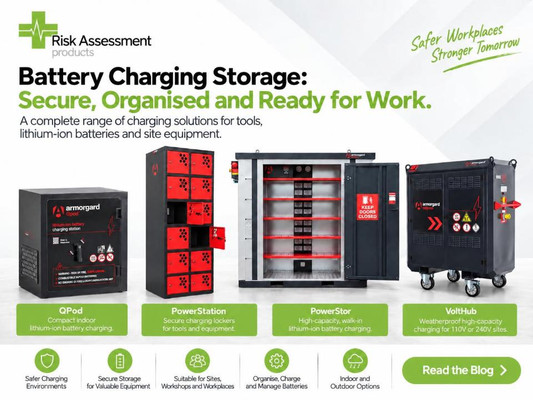
The RAP range is now organised into four main subcategories:
Tools Charging Lockers
For secure compartment-based charging of tools, batteries and workplace devices.
QPod
For compact indoor lithium-ion battery charging and storage.
PowerStor
For larger walk-in lithium-ion charging requirements.
VoltHub
For high-capacity site charging, including 110V and 240V environments.
The most suitable category depends on capacity, environment, power supply and how much access control is required.
Tools Charging Lockers
Tools Charging Lockers are designed for workplaces that need to charge tools and portable equipment while keeping individual items separated and secured.
The current range includes both Armorgard PowerStation lockers and RAP-branded 4- and 6-door charging lockers.
These can be suitable for:
- construction sites;
- workshops;
- engineering departments;
- maintenance teams;
- factories;
- warehouses; and
- shared workplaces.
Armorgard PowerStation Charging Lockers
The Armorgard PowerStation range includes 6 and 12 compartment models with either key-operated or padlock-compatible locking options.
For example:
PowerStation 6 Locker Charging Unit - Key Cam Lock
PowerStation 6 Locker Charging Unit - Padlock Cam Lock
PowerStation 12 Locker Charging Unit - Key Cam Lock
PowerStation 12 Locker Charging Unit - Padlock Cam Lock
These are useful where different workers need their own secure charging compartment.
QPod: Compact Lithium-Ion Battery Charging
The Armorgard QPod QP1 is designed for organisations that need a compact indoor lithium-ion battery charging solution.
It is suitable for batteries with a combined capacity of up to 1.5 kWh and is much smaller than a walk-in charging unit.
The QPod can be useful in:
- workshops;
- maintenance departments;
- warehouses;
- engineering areas;
- facilities teams; and
- smaller commercial environments.
Its compact format makes it suitable where a dedicated charging area is required but floor space is limited.
Who Is QPod Best For?
QPod is most appropriate where:
- battery volumes are relatively modest;
- charging takes place indoors;
- a dedicated lithium-ion charging unit is preferred; and
- a full walk-in charging store would be excessive.
Browse QPod Lithium-Ion Charging
PowerStor: Walk-In Lithium-Ion Battery Charging
For larger battery fleets, the Armorgard PowerStor range provides walk-in lithium-ion charging and storage.
The current RAP range includes:
- PowerStor PWR1
- PowerStor PWR1-LS with lockable shelves
- PowerStor PWR2-LS with lockable shelves
- PowerStor PWR2
The PWR1 is a walk-in lithium-ion battery charging unit with 32 charging sockets and integrated systems designed for larger on-site battery fleets.
PowerStor PWR2
The PWR2 provides a deeper two-metre configuration while retaining 32 RCD-protected charging points.
PowerStor with Lockable Shelves
The PWR1-LS and PWR2-LS versions add lockable internal shelving.
This can help where:
- multiple contractors share the same charging area;
- equipment needs to be separated by team;
- higher-value chargers need restricted access; or
- site managers want greater accountability.
Who Is PowerStor Best For?
PowerStor is most relevant to:
- major construction projects;
- engineering operations;
- infrastructure sites;
- plant depots;
- large maintenance facilities; and
- organisations operating substantial cordless-tool fleets.
Browse PowerStor Lithium-Ion Charging Units
VoltHub: High-Capacity Site Charging
The VoltHub range is designed for sites that need high-capacity battery charging in more demanding environments.
RAP currently offers 16-locker VoltHub charging stations in 110V and 240V versions.
VoltHub 110V
The VoltHub VH16-110 is designed around 110V site power and is particularly relevant to construction environments.
Its specification includes:
- 16 individual lockers;
- RCD-protected charging;
- IP55-rated construction;
- audible and visual alarms;
- site mobility features; and
- a weather-resistant enclosure.
VoltHub 240V
The VoltHub VH16-240 provides the same type of high-capacity approach for 240V environments.
It is suited to industrial, commercial and construction applications where secure charging for larger numbers of batteries is required.
Who Is VoltHub Best For?
VoltHub may be appropriate for:
- construction sites;
- infrastructure projects;
- plant and equipment operations;
- industrial sites;
- renewable-energy projects;
- facilities management teams; and
- locations where charging takes place outside a conventional workshop.
Browse VoltHub Battery Charging Stations
What Is the Difference Between the Four Categories?
| Category | Best suited to | Main benefit |
| Tools Charging Lockers | Workplaces and shared teams | Individual secure charging compartments |
| QPod | Smaller indoor battery fleets | Compact dedicated lithium-ion charging |
| PowerStor | Large battery fleets | Walk-in lithium-ion charging capacity |
| VoltHub | Construction and industrial sites | High-capacity 110V or 240V site charging |
Battery Charging Storage for Construction Sites
Construction sites are one of the strongest applications for dedicated charging equipment.
Modern sites often rely heavily on cordless equipment used by:
- electricians;
- plumbers;
- carpenters;
- engineers;
- fit-out teams;
- maintenance contractors; and
- groundworkers.
For smaller teams, Tools Charging Lockers may provide enough capacity.
For larger battery fleets, PowerStor or VoltHub may be more appropriate.
Where site power is 110V, the VoltHub 110V model is specifically designed for that type of environment.
Battery Charging Storage for Workshops and Maintenance Teams
Indoor workshops may have very different requirements from a major construction site.
For secure individual charging, Tools Charging Lockers may be the best fit.
Where lithium-ion battery management is the primary concern, QPod provides a more specialist compact option.
The deciding factor is whether the requirement is mainly:
secure compartment charging
or
dedicated lithium-ion battery charging and storage.
What Should You Consider Before Buying?
How Many Batteries or Tools Need Charging?
A team of four users has a very different requirement from a site running dozens of battery-powered tools.
Indoor or Outdoor Use?
Some products are designed primarily for indoor environments, while others are better suited to demanding site conditions.
QPod, for example, is an indoor charging unit, while VoltHub is designed for more exposed site use.
What Voltage Is Available?
Check whether your site uses:
- standard UK 240V;
- 110V site power; or
- standard 13A sockets.
The charging equipment must match the available power supply.
Do Users Need Separate Lockers?
If multiple workers or contractors share the same charging area, individual lockers may provide better control.
How Large Is the Battery Fleet?
Small teams may only need a compact cabinet or locker bank.
Larger operations may require a high-capacity or walk-in unit.
Does the Equipment Need to Move?
Some construction environments need charging stations that can be repositioned as a project develops.
This can make forklift or crane-handling features important.
Are All Battery Charging Lockers the Same?
No.
This distinction is important.
A standard charging locker may primarily provide:
- secure compartments;
- individual sockets;
- locking doors; and
- organised charging.
Specialist lithium-ion charging products may incorporate additional features specifically intended for battery charging risk management.
Do not assume every locker with a power socket offers the same specification.
Always check the individual product details.
Are Battery Charging Lockers Fireproof?
Not necessarily.
“Battery charging locker” is a broad term and does not automatically mean fire-rated or fireproof.
Some products are designed primarily to provide secure charging, while specialist products such as QPod, PowerStor and VoltHub incorporate features intended specifically for lithium-ion battery charging environments.
Choose equipment according to the product specification and your own risk assessment rather than relying on generic terminology.
Why Separate Tool Charging from General Storage?
A charging locker is not simply a standard locker with power added.
Purpose-designed charging storage can help:
- keep cables controlled;
- separate users;
- organise chargers;
- reduce improvised charging arrangements;
- keep valuable equipment secured; and
- provide a defined charging area.
This can be particularly useful on shared sites where many contractors use battery-powered equipment.
Frequently Asked Questions
What is a tool charging locker?
A tool charging locker is a powered storage unit that allows tools, batteries or portable devices to be charged inside individual secure compartments.
What is the best charging storage for a small workshop?
For individual secure charging, a Tools Charging Locker may be suitable. Where dedicated lithium-ion battery charging is the priority, QPod may be more appropriate.
What is the difference between QPod and PowerStor?
QPod is a compact indoor lithium-ion charging unit. PowerStor is a much larger walk-in charging system designed for high-capacity battery fleets.
What is VoltHub used for?
VoltHub is a high-capacity battery charging station available in 110V and 240V versions for construction and industrial environments.
Are there charging lockers with separate compartments?
Yes. RAP offers multiple locker-based solutions including 4, 6 and 12 compartment configurations.
How many charging points does PowerStor have?
Current PWR1 and PWR2 PowerStor models provide 32 charging sockets.
Is VoltHub available in 110V?
Yes. RAP currently supplies both 110V and 240V VoltHub 16-locker charging stations.
Choose the Right Battery Charging Storage
The correct charging solution depends on the size and environment of your operation.
Choose Tools Charging Lockers where individual users need secure powered compartments.
Choose QPod where you need compact indoor lithium-ion battery charging.
Choose PowerStor where larger battery fleets require high-capacity walk-in charging.
Choose VoltHub for high-capacity construction and industrial charging in 110V or 240V environments.
Risk Assessment Products supplies:
- Tools Charging Lockers
- QPod Lithium-Ion Charging Units
- PowerStor Battery Charging Units
- VoltHub Charging Stations
Browse All Battery Charging Storage
For larger sites, assess the complete charging process before purchasing: what is being charged, where charging takes place, who needs access and how many batteries need to be managed at the same time.
Recent Posts
-
Battery Charging Storage: How to Choose the Right Solution for Tools, Lithium-Ion Batteries and Site Equipment
Rechargeable batteries are now central to many workplaces. Construction sites, workshops, engineerin …14th Sep 2026 -

Back to School: How Educational Storage Trolleys Can Help Create a Better-Organised Classroom
The first few weeks of a new school term are often when classroom storage problems become most obvio …13th Sep 2026 -

Bleed Control Kits: What Are They and Who Should Have One?
A bleed control kit is designed to provide equipment for responding to life-threatening external ble …9th Sep 2026