
Bleed Control Kits: What Are They and Who Should Have One?
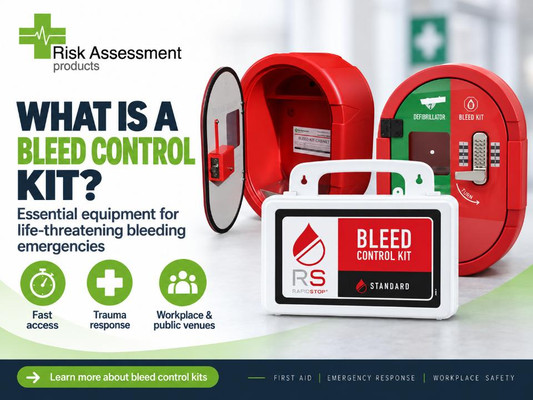
A bleed control kit is designed to provide equipment for responding to life-threatening external bleeding before the emergency services arrive.
Severe bleeding can become critical very quickly, so having the right equipment available — and knowing where it is — can be an important part of workplace, venue and public-access first-aid planning.
Current Resuscitation Council UK first-aid guidance recommends an escalating approach to life-threatening bleeding: call 999, apply firm direct pressure, use a suitable dressing, and apply a tourniquet as soon as possible for life-threatening limb bleeding that is not controlled by direct pressure.
Risk Assessment Products supplies a range of Bleed Control & Trauma equipment including bleed control kits, Public Access Trauma (PAcT) kits, tourniquets, signs and dedicated cabinets.
What Is a Bleed Control Kit?
A bleed control kit contains equipment intended to help control serious bleeding until professional medical help arrives.
The exact contents vary between products, but bleed control equipment may include items such as:
- tourniquets;
- trauma dressings;
- gloves;
- scissors;
- wound dressings;
- CPR face shields; and
- instructions or aide-mémoires.
The equipment required should reflect the risks of the location and the organisation’s first-aid needs assessment.
What Is Life-Threatening Bleeding?
Life-threatening bleeding is severe blood loss that requires immediate action.
Warning signs may include:
- heavy or uncontrolled bleeding;
- blood flowing continuously or spurting from a wound;
- bleeding that does not stop with firm pressure;
- severe limb injuries;
- partial or complete amputation; or
- signs that the casualty is becoming pale, weak, confused or unresponsive.
If severe bleeding is suspected, call 999 immediately.
Resuscitation Council UK recommends firm direct pressure to the bleeding site, followed where appropriate by wound dressings and a tourniquet for life-threatening bleeding from a limb that is not controlled with direct pressure.
What Is a Tourniquet Used For?
A tourniquet is used to control life-threatening bleeding from an arm or leg.
It is not intended for routine minor bleeding.
Current UK first-aid guidance states that, for life-threatening extremity bleeding that is not controlled by direct manual pressure, a tourniquet should be applied as soon as possible. It should normally be positioned 5-7 cm above the injury and not over a joint, tightened until the bleeding stops, and the application time should be recorded. Once applied, it should not be released by a first aider.
The RAP range includes the TMT Tourniquet Civilian Model (Orange), a high-visibility windlass tourniquet intended for the control of life-threatening limb bleeding.
What Is a Public Access Trauma Kit?
A Public Access Trauma (PAcT) First Aid Kit is intended for publicly accessible locations where members of the public may need to respond to serious injuries before emergency services arrive.
ProtectUK states that PAcT kits are designed for use by any person, regardless of their level of training, and are intended to support the treatment of life-threatening injuries.
ProtectUK’s current PAcT standard specifies contents including:
- four pairs of disposable gloves;
- disposable eye protection;
- disposable face masks;
- two Tuff-Cut scissors;
- four large trauma wound dressings;
- two triangular bandages;
- two tourniquets;
- two CPR face shields;
- two permanent marker pens; and
- two tourniquet/application information aids.
Risk Assessment Products supplies a Public Access Trauma (PAcT) First Aid Kit which includes two RapidStop tourniquets and is designed for fast response to serious bleeding emergencies.
Where Should PAcT Kits Be Located?
Accessibility is critical.
ProtectUK says PAcT kits should be placed in publicly accessible locations where people can reach them quickly. Suggested areas may include:
- main entrances;
- receptions;
- fire exits;
- refuge areas;
- canteens;
- muster points;
- ticket halls;
- platforms;
- loading bays; and
- vehicles.
The most appropriate location should be determined through a risk-based assessment, taking account of the size, layout and use of the premises.
Kits should also be clearly identifiable.
ProtectUK recommends use of the agreed Public Access Trauma First Aid Kit sign so that emergency equipment can be distinguished quickly from ordinary first-aid provision.
Risk Assessment Products supplies a Public Access Trauma (PAcT) Kit Sign designed to support clear identification of PAcT equipment.
Do Workplaces Need Bleed Control Kits?
There is no blanket UK rule requiring every workplace to have a dedicated bleed control kit.
Under the Health and Safety (First-Aid) Regulations 1981, employers must provide adequate and appropriate first-aid equipment, facilities and personnel based on their circumstances.
ProtectUK recommends that organisations assess whether their existing first-aid arrangements are capable of dealing with immediate life-threatening injuries, including major bleeding.
A bleed control or trauma kit may be particularly relevant for locations such as:
- manufacturing and engineering sites;
- warehouses;
- construction environments;
- transport hubs;
- shopping centres;
- entertainment venues;
- schools and colleges;
- sports facilities;
- hospitality venues;
- public buildings; and
- locations with significant public footfall.
The need should always come from the organisation’s first-aid needs assessment and risk profile.
Bleed Control Kit vs Standard First Aid Kit
A standard workplace first aid kit is designed to deal with a broad range of common injuries.
A bleed control kit is more specialised.
It focuses on equipment that may be required where severe blood loss poses an immediate threat to life.
Depending on the risks involved, an organisation may therefore decide that a trauma or bleed control kit should supplement, rather than replace, its normal workplace first-aid provision.
ProtectUK specifically describes PAcT kits as a way of enhancing an organisation’s existing first-aid preparedness.
RapidStop Bleed Control Kit
The RapidStop Bleed Control Kit - Standard is a compact emergency kit intended for serious bleeding incidents.
It includes a RapidStop tourniquet for the control of life-threatening limb bleeding and is supplied in a robust weather-resistant case for protection and accessibility.
This type of compact kit can be useful where organisations want bleed-control equipment that can be:
- stored at a first-aid point;
- mounted in a visible location;
- carried to an incident; or
- positioned alongside other emergency equipment.
Why Use a Bleed Control Cabinet?
A cabinet can make emergency equipment easier to locate while also helping protect it from damage, interference or environmental exposure.
RAP currently supplies several dedicated options, including:
- Bleed Control Cabinet – Unlocked – Red;
- Bleed Control Cabinet – Locked – Red;
- DefibSafe 2 Outdoor Defibrillator & Bleed Kit Cabinet – Locked.
The choice between locked and unlocked storage should balance security against rapid accessibility.
For publicly accessible emergency equipment, unnecessary delays should be avoided. ProtectUK guidance emphasises that first-aid provisions should be clearly visible and readily accessible.
Combined AED and Bleed Control Stations
For some locations, it can make sense to position bleed control equipment alongside an automated external defibrillator.
The emergencies are different:
- an AED is used during suspected cardiac arrest;
- a bleed control kit is used for severe traumatic bleeding.
But both are time-critical emergency responses.
RAP supplies the DefibSafe 2 Outdoor Defibrillator & Bleed Kit Cabinet, which provides heated outdoor storage for both an AED and bleed control equipment in a single emergency-response location.
There is also a Free Standing AED and Bleed Kit Mount for sites where wall mounting is not practical.
This type of combined installation may be particularly relevant for:
- sports grounds;
- schools;
- industrial estates;
- transport sites;
- community centres;
- large workplaces; and
- public-access areas.
How Should Bleed Control Equipment Be Managed?
Installing a kit is only part of the process.
Organisations should also have a plan for:
- checking contents regularly;
- monitoring expiry dates;
- replacing used or damaged items;
- ensuring seals and packaging remain intact;
- maintaining clear signage;
- keeping access routes unobstructed;
- making staff aware of the kit location; and
- incorporating the kit into emergency response planning.
ProtectUK specifically recommends that PAcT kits form part of an organisation’s first-aid needs assessment and response plan, with clear responsibility for their location and management.
Do Staff Need Training to Use a Bleed Control Kit?
PAcT kits are specifically intended so that they can be used by members of the public regardless of previous training.
However, training and familiarisation can still be valuable.
Resuscitation Council UK notes as a general principle that people should use specialist equipment within their competence and training, and ProtectUK recommends that organisations consider additional awareness training for staff responsible for emergency response.
Training may help staff become familiar with:
- recognising life-threatening bleeding;
- applying direct pressure;
- using trauma dressings;
- applying a tourniquet;
- calling 999;
- locating emergency equipment; and
- integrating bleed control into the wider emergency response.
What Should You Look for When Choosing a Bleed Control Kit?
When comparing kits, consider:
Intended Setting
Is the kit for a workplace, vehicle, public venue or outdoor installation?
Contents
Check whether the kit includes appropriate trauma dressings, tourniquets, PPE and other equipment for the risks identified.
Accessibility
Can somebody retrieve it quickly in an emergency?
Visibility
Is it clearly labelled and signposted?
Storage
Does it need a cabinet, wall bracket or weather-resistant enclosure?
Number of Casualties
A larger public-access location may require equipment capable of supporting more than one casualty.
Ongoing Maintenance
Make sure replacement consumables can be sourced and expiry dates can be managed.
Frequently Asked Questions
What is a bleed control kit?
A bleed control kit contains equipment intended to help manage serious or life-threatening bleeding before professional medical help arrives.
Are bleed control kits a legal requirement?
Not for every UK workplace. Employers must provide adequate and appropriate first-aid arrangements based on their first-aid needs assessment. A dedicated bleed control kit may be appropriate where the identified risks justify one.
What is a PAcT kit?
PAcT stands for Public Access Trauma. These kits are designed for publicly accessible locations and support the treatment of immediate life-threatening injuries. ProtectUK states that they can be used by any person, regardless of training.
What is a tourniquet used for?
A tourniquet is used for life-threatening bleeding from an arm or leg when direct pressure has not controlled the bleeding.
Should a bleed kit be locked?
There is no one answer for every site. Security has to be balanced against emergency accessibility. Public-access provisions should be easy to identify and retrieve without unnecessary delay.
Can a bleed control kit replace a normal first aid kit?
Usually not. Bleed control kits are specialist emergency equipment intended to supplement wider first-aid provision rather than replace it.
Where should a trauma kit be installed?
The location should follow a risk assessment. Public-facing sites should prioritise visibility, accessibility and locations people can reach quickly during an emergency.
Prepare for Serious Bleeding Emergencies
Major bleeding is time-critical.
Effective emergency planning means having suitable equipment available, making sure people can find it quickly and ensuring first-aid arrangements reflect the actual risks of the site.
Risk Assessment Products supplies:
- Bleed Control Kits;
- Public Access Trauma Kits;
- Tourniquets;
- Bleed Control Cabinets;
- PAcT Kit Signage; and
- combined AED and bleed-control storage solutions.
Browse Bleed Control & Trauma Equipment
Recent Posts
-
Workplace First Aid & Emergency Response: Is Your Business Properly Prepared?
Accidents and medical emergencies can happen in any workplace, from offices and schools to warehouse …23rd Oct 2026 -
Is One Defibrillator Enough? AED Coverage for Large UK Workplaces
Having a defibrillator on site is an important step towards workplace emergency preparedness. But wh …16th Oct 2026 -
Mobile First Aid Storage: Wheeled First Aid Cabinets for Large Workplaces
When an emergency happens, first aid equipment needs to be accessible, wherever the incident occurs. …8th Oct 2026