
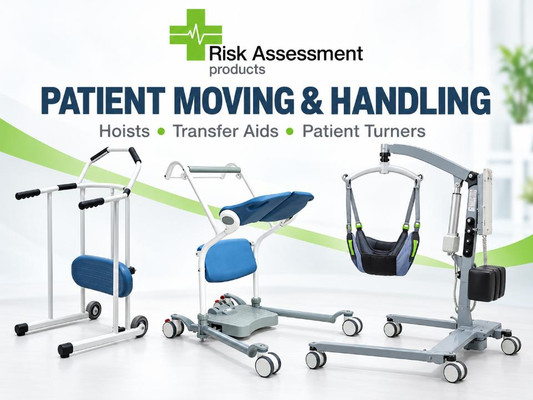
Patient Moving and Handling Equipment: How to Choose Hoists, Transfer Aids and Patient Turners
Moving and handling a person safely requires the right equipment, an appropriate assessment and trained carers or healthcare staff.
The correct aid depends on factors such as the person’s mobility, ability to bear weight, upper-body strength, balance, transfer distance and the environment in which the transfer takes place.
Risk Assessment Products supplies a range of moving and handling equipment and patient turners and transfer aids for care homes, hospitals, clinics and home-care environments.
What Is Patient Moving and Handling Equipment?
Patient moving and handling equipment is designed to help carers and healthcare professionals move or transfer a person more safely.
Depending on the user’s needs, this can include:
- mobile hoists;
- stand-and-turn aids;
- transfer platforms;
- sit-to-stand aids;
- standing supports;
- toilet stand-up aids; and
- other equipment designed to reduce the physical effort involved in moving a person.
The right equipment should be selected following an appropriate moving and handling assessment.
Why Is the Right Transfer Equipment Important?
Using unsuitable equipment can increase risk for both the person being moved and the carer.
Appropriate transfer equipment can help:
- reduce manual lifting;
- support safer movement between seated positions;
- improve stability during transfers;
- maintain dignity and confidence;
- reduce strain on carers;
- make transfers more controlled; and
- support independence where the person is still able to participate.
The aim is not simply to move someone from one place to another. It is to select equipment appropriate to the person’s abilities and the task.
Hoist or Transfer Aid: What Is the Difference?
This is one of the most important distinctions.
A patient hoist is designed to lift and transfer a person using an appropriate sling.
A transfer aid or patient turner generally requires the person to participate to some degree, for example by standing, weight-bearing or holding onto the device.
That means a transfer platform is not a substitute for a hoist when the person cannot safely bear weight or participate in the transfer.
When Might a Patient Hoist Be Appropriate?
A hoist may be considered where a person cannot safely complete a standing or pivoting transfer using a simpler aid.
The Samsoft Elite Electric Leg Opening 180kg Hoist in the RAP range is a compact mobile hoist designed for patient transfers, with electrically operated leg opening and a maximum user weight of 180 kg. (risk-assessment-products.co.uk)
A mobile hoist may be used for transfers such as:
- chair to chair;
- wheelchair to chair;
- toileting;
- other assessed patient transfers.
The correct sling and transfer method should always be selected for the individual.
When Is a Patient Turner or Transfer Platform More Suitable?
A patient turner or transfer platform may be appropriate where the person:
- can bear weight through their legs;
- has sufficient upper-body strength;
- can follow instructions;
- can maintain an appropriate level of balance; and
- is able to participate actively in the transfer.
The current RAP range includes the Orbital Transfer Platform and Orbital Transfer Platform with Knee Support. These are intended for people who are weight-bearing and have good upper-body strength, allowing controlled transfers between seated positions. (risk-assessment-products.co.uk)
Orbital Transfer Platform
The Orbital Transfer Platform is designed to assist a weight-bearing person when transferring between seated positions.
The platform pivots between the two surfaces, allowing the user and carer to complete a controlled standing transfer rather than carrying out a manual lift. (risk-assessment-products.co.uk)
Typical transfers may include:
- chair to wheelchair;
- wheelchair to chair;
- chair to toilet;
- other nearby seated surfaces.
It is not intended for a person who cannot safely weight-bear.
Orbital Transfer Platform With Knee Support
The Orbital Transfer Platform with Knee Support adds support around the lower leg/knee area.
This can provide additional stability during the standing and turning phase of the transfer.
As with the standard version, the person still needs appropriate weight-bearing ability and upper-body control.
Motion Transfer Aid
The Motion Transfer Aid is designed to assist with standing, transferring and toileting.
It includes:
- multiple hand-grip positions;
- adjustable padded leg support;
- a low platform;
- easy-roll wheels;
- single-action braking; and
- a maximum user weight of 150 kg.
The product is designed to encourage forward knee movement during sitting and standing, helping support a more natural transfer action.
Boost Adjustable Transfer Aid
The Boost Adjustable Transfer Aid is another option within the current range.
It is designed to support standing transfers while allowing the person to participate actively in the movement.
This type of aid may be useful where the user needs more support than a simple transfer platform but can still contribute to the transfer.
The exact suitability should depend on the individual assessment rather than the product alone.
Toilet Stand-Up Aid
Toileting is one of the most common situations where assisted standing can be difficult.
The Toilet Stand-up Aid eTSE provides powered assistance for people who need additional help sitting down onto or standing up from the toilet.
It has a maximum capacity of 150 kg and is designed as a higher-support option than basic toilet frames or grab rails.
This type of equipment can help support dignity and independence where the person can participate but needs additional powered assistance.
How Do You Choose the Right Moving and Handling Aid?
There is no single best transfer aid.
The following factors should be considered.
Can the Person Bear Weight?
This is one of the first questions.
If the person cannot safely bear weight, a stand-and-turn platform may not be appropriate.
A hoist-based solution may be required instead.
Can They Participate in the Transfer?
Transfer aids generally rely on the person being able to:
- understand instructions;
- hold onto the aid;
- stand with support;
- maintain sufficient balance.
If they cannot actively participate, another method should be considered.
What Is Their Upper-Body Strength?
Some transfer platforms require the person to hold handles or rails during the movement.
Good grip and upper-body control can therefore be important.
What Transfer Is Being Carried Out?
The correct equipment may differ depending on whether the transfer is:
- chair to wheelchair;
- wheelchair to toilet;
- chair to chair;
- bedside transfer;
- standing from a toilet;
- another care activity.
How Much Space Is Available?
Room layout matters.
Consider:
- turning space;
- door widths;
- furniture;
- toilet areas;
- flooring;
- whether the equipment needs to be stored between uses.
What Is the User Weight?
Every product has a specified maximum user weight.
For example:
- Motion Transfer Aid – 150 kg;
- Toilet Stand-up Aid eTSE – 150 kg;
- Samsoft Elite Hoist – 180 kg. (risk-assessment-products.co.uk)
Never exceed the product’s stated safe working limit.
Why Transfer Aids Should Not Be Chosen on Price Alone
Transfer equipment needs to suit the individual user and care environment.
Two products that look similar may have different:
- user weight limits;
- support points;
- dimensions;
- braking systems;
- manoeuvrability;
- adjustment options;
- intended transfer methods.
The lowest-cost product is therefore not necessarily the most appropriate.
Moving and Handling Assessments
Equipment selection should form part of a proper moving and handling assessment.
The assessment should consider:
- the individual’s mobility;
- weight-bearing ability;
- cognitive ability;
- strength and balance;
- medical or clinical considerations;
- the task being carried out;
- the environment;
- number of carers required;
- suitable equipment.
Where there is doubt about the appropriate transfer method, seek assessment from a suitably competent healthcare or moving-and-handling professional.
Patient Independence and Transfer Equipment
One of the advantages of stand-and-turn aids is that they can allow some people to remain actively involved in their own transfer.
Rather than being fully lifted, the person may be able to:
- stand;
- grip handles;
- rotate with support;
- sit onto the new surface.
For suitable users, maintaining participation can help preserve confidence and independence.
The key phrase is for suitable users - the person’s ability should always be assessed first.
Moving and Handling Equipment for Care Homes
Care homes often need several types of transfer equipment because residents may have very different mobility levels.
A typical range might include:
- mobile hoists;
- stand-and-turn aids;
- transfer platforms;
- toileting aids.
This allows carers to choose equipment according to each resident’s moving and handling plan rather than relying on one solution for everyone.
Moving and Handling Equipment for Hospitals and Clinics
Healthcare settings may need equipment for:
- ward transfers;
- outpatient areas;
- rehabilitation;
- toileting;
- treatment areas;
- discharge and mobility assessment.
Compact mobile equipment can be particularly useful where the same device needs to move between rooms.
Transfer Aids for Home-Care Environments
Transfer aids can also be used in suitable home-care settings.
Important considerations include:
- room dimensions;
- flooring;
- doorways;
- storage;
- carer access;
- whether the aid can turn safely within the available space.
A product that works well in a large care-home room may not necessarily suit a smaller domestic bathroom or bedroom.
What Should Be Checked Before Each Use?
Follow the manufacturer’s instructions for the particular product.
A basic pre-use check may include:
- wheels or castors;
- brakes;
- handles;
- footplates;
- knee supports;
- adjustment mechanisms;
- obvious damage;
- cleanliness;
- any sling or accessory used with a hoist.
If equipment is damaged or not operating correctly, remove it from use until it has been assessed.
Frequently Asked Questions
What is a patient transfer aid?
A patient transfer aid is equipment designed to help move a person between positions or surfaces, often while allowing them to participate in the transfer.
What is a patient turner?
A patient turner is a standing transfer device that helps a weight-bearing person rotate between nearby seated positions.
Can a transfer aid replace a hoist?
Not necessarily.
Transfer aids are generally intended for people who can weight-bear and participate. A hoist may be required where a person cannot safely do this.
Who can use an Orbital Transfer Platform?
The Orbital Transfer Platform is designed for people who are weight-bearing and have good upper-body strength.
What is the maximum weight for the Motion Transfer Aid?
The Motion Transfer Aid has a maximum user weight of 150 kg.
What is the maximum user weight for the Samsoft Elite Hoist?
The current Samsoft Elite model listed by RAP has a maximum user weight of 180 kg.
Are transfer aids suitable for home care?
They can be, provided the person has been appropriately assessed and the home environment has sufficient space for the equipment to be used safely.
Should staff be trained to use patient-handling equipment?
Yes. Staff should be trained and competent to use the specific equipment and transfer technique required for the individual.
Choose the Right Moving and Handling Equipment
The correct transfer equipment depends on the person, the task and the environment.
For someone who cannot safely participate in a standing transfer, a patient hoist may be the appropriate option.
For a person who can weight-bear and has sufficient strength and balance, a patient turner or transfer platform may provide a more active and controlled transfer.
For specific situations such as toileting, a dedicated stand-up aid may be more suitable.
Risk Assessment Products supplies:
- Moving & Handling Equipment
- Patient Turners & Transfer Aids
- Samsoft Elite patient hoists
- Orbital transfer platforms
- Motion Transfer Aids
- Boost Adjustable Transfer Aids
- Toilet Stand-up Aids
The key is to match the equipment to the assessed needs of the individual rather than choosing by product type alone.
Recent Posts
-
Patient Moving and Handling Equipment: How to Choose Hoists, Transfer Aids and Patient Turners
Moving and handling a person safely requires the right equipment, an appropriate assessment and trai …17th Sep 2026 -
Battery Charging Storage: How to Choose the Right Solution for Tools, Lithium-Ion Batteries and Site Equipment
Rechargeable batteries are now central to many workplaces. Construction sites, workshops, engineerin …14th Sep 2026 -

Back to School: How Educational Storage Trolleys Can Help Create a Better-Organised Classroom
The first few weeks of a new school term are often when classroom storage problems become most obvio …13th Sep 2026