
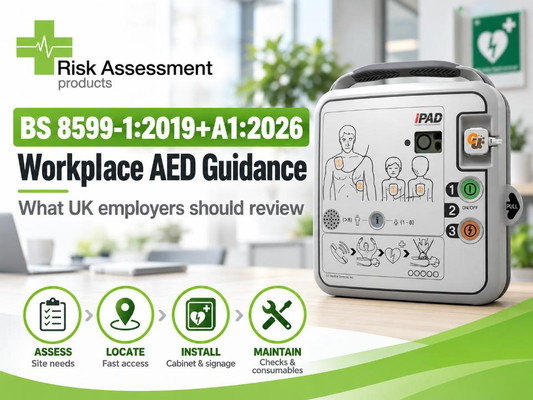
BS 8599-1:2019+A1:2026: What the New Workplace AED Guidance Means
BS 8599-1:2019+A1:2026: What the New Workplace AED Guidance Means for UK Employers
The British Standard for workplace first aid has been updated.
BS 8599-1:2019+A1:2026 expands the existing workplace first-aid standard to include the provision of Automated External Defibrillators (AEDs) in the workplace.
For employers, facilities managers, health and safety professionals and workplace first aiders, this is an important development.
The amendment increases the emphasis on not simply owning a defibrillator, but making sure it is:
- appropriate for the workplace;
- easy to find;
- positioned where it can be reached quickly;
- stored appropriately;
- accessible when needed; and
- properly managed after installation.
It does not mean that a new UK law suddenly requires every workplace to install an AED.
Instead, employers should review their first-aid arrangements and consider AED provision as part of their first-aid needs assessment.
What Is BS 8599-1:2019+A1:2026?
BS 8599-1 is the British Standard covering workplace first-aid equipment.
The 2026 amendment changes the title and scope so that it now covers:
“Contents of first aid kits and provision of Automated External Defibrillators (AEDs) in the workplace.” (you can purchase the guidance online at British Standards).
Previous versions focused principally on workplace first-aid kit contents.
The amended version now also addresses areas including:
- workplace AED provision;
- burns first-aid kits;
- eyewash provision; and
- the needs of people other than employees, including contractors and visitors.
When Was BS 8599-1:2019+A1:2026 Published?
The amendment was published in April 2026.
BSI’s standards-development record shows publication activity beginning on 24 April 2026, while industry publication announcements widely cite 30 April 2026.
For practical workplace purposes, this is now the current amended version of BS 8599-1.
Does BS 8599-1:2019+A1:2026 Make Workplace AEDs a Legal Requirement?
No, not by itself.
A British Standard is not the same thing as legislation.
The Health and Safety Executive states that workplace first-aid arrangements should be based on the employer’s first-aid needs assessment. HSE also says that although employers should look for BS 8599 when buying first-aid equipment, there is no legal requirement for a first-aid kit itself to comply with the standard.
The same distinction is important when discussing AEDs.
The new amendment represents recognised best-practice guidance, rather than a blanket statutory rule that every workplace must buy a defibrillator.
However, the fact that AED provision now sits explicitly within a recognised national workplace first-aid standard makes it much more important for employers to document that they have considered AED provision.
What Does the New Standard Say About AEDs?
Industry guidance interpreting the amended standard consistently reports that workplaces with five or more people present during operating hours should consider provision of an AED that is:
- clearly displayed;
- wall mounted or kept in a suitable cabinet;
- accessible within approximately two minutes from all areas of the workplace; and
- available to the public where practicable.
This is a significant shift in emphasis.
The question is no longer simply:
“Do we own a defibrillator?”
It becomes:
“Can someone actually get that defibrillator to a casualty quickly enough?”
What Is the Two-Minute AED Principle?
The most discussed part of the 2026 update is the expectation that an AED should be reachable quickly across the workplace.
Industry interpretations of BS 8599-1:2019+A1:2026 describe this as a two-minute accessibility expectation.
That has practical implications for larger sites.
One AED at reception may be perfectly accessible in a small office.
The same single AED may be inadequate for:
- a large warehouse;
- a multi-storey office;
- a manufacturing plant;
- a construction site;
- a distribution centre;
- a large school campus; or
- a site split across several buildings.
The important consideration is therefore retrieval time, not simply the number of AEDs purchased.
Why Does AED Retrieval Time Matter?
Cardiac arrest is time critical.
Resuscitation Council UK states that the best chance of successful resuscitation occurs when CPR and defibrillation are carried out with minimal delay. Its AED guidance notes that survival rates above 70% have been reported where defibrillation occurs within three minutes of collapse in some settings.
That is why accessibility matters as much as ownership.
An AED that is:
- locked in an office;
- stored in a cupboard;
- poorly signposted;
- several floors away; or
- inaccessible outside normal hours
may provide much less practical benefit during an emergency.
Does a Workplace With Five or More People Automatically Need an AED?
This is where employers should be cautious about simplified headlines.
Some suppliers are currently presenting the amendment as:
“All workplaces with five or more people require an AED.”
That wording is stronger than the legal position.
The more accurate approach is:
- the amended British Standard sets out AED provision expectations;
- employers should consider those expectations within their first-aid needs assessment;
- workplace size, footfall, site layout and risk all matter;
British Standards are not legislation in themselves.
HSE’s overarching approach remains risk based.
- Resuscitation Council UK also recommends assessing factors such as:
- number of people present;
- age profile;
- footfall;
- nature of the workplace;
- specific occupational risks;
- consequences of cardiac arrest; and
- accessibility of emergency equipment.
How Should Employers Assess AED Provision?
A sensible workplace review should consider:
Number of people on site
Include:
- employees;
- contractors;
- visitors;
- customers;
- members of the public.
The 2026 standard places greater emphasis on the total number of people who may be present, rather than employees alone.
Site size
Large sites may require more than one AED to achieve reasonable accessibility.
Number of floors
A defibrillator on the ground floor may not be quickly accessible from upper floors.
Separate buildings
Sites containing multiple buildings should consider realistic retrieval routes.
Restricted areas
Security doors, turnstiles and controlled-access zones can significantly increase AED retrieval time.
Footfall
Busy public-facing environments can carry a greater likelihood of cardiac arrest simply because more people pass through them.
Workforce demographics
Resuscitation Council UK notes that cardiac arrest risk increases with age. Resuscitation Council UK
Workplace activity
Physical exertion and certain workplace hazards may affect the assessment.
Use Our Free Defibrillator Site Assessment Form
Risk Assessment Products provides a free Defibrillator Site Assessment Form to help organisations review:
- workforce and visitor numbers;
- site layout;
- existing AED provision;
- retrieval barriers;
- potential AED locations;
- storage requirements;
- signage;
- public accessibility;
- The Circuit registration;
- inspection arrangements; and
- responsibility for ongoing management.
Download the Free Defibrillator Site Assessment Form
Where Should a Workplace AED Be Located?
A workplace defibrillator should be positioned where people can find and retrieve it quickly.
A suitable location should generally be:
- clearly visible;
- well signposted;
- accessible during operating hours;
- familiar to staff;
- appropriate for the AED’s environmental requirements; and
free from unnecessary access barriers.
Avoid locations such as:
- locked management offices;
- unmarked cupboards;
- inaccessible back rooms;
- areas requiring several security permissions.
Indoor AED Storage
For indoor workplaces, storage options may include:
- wall brackets;
- indoor cabinets;
- alarmed cabinets; and
- carrying cases.
A visible cabinet can make the AED easier to identify in an emergency.
Outdoor AED Storage
Outdoor AEDs require greater environmental protection.
Depending on the AED and installation location, an outdoor cabinet may need:
- weather protection;
- temperature management;
- clear external identification;
- secure mounting; and
- suitable access arrangements.
Risk Assessment Products supplies outdoor options including the DefibSafe 2 range.
Should an AED Be Locked?
For emergency equipment, access speed matters.
Where a defibrillator is intended for public access, unnecessary barriers should be avoided.
Resuscitation Council UK guidance also emphasises that AED location and accessibility should be easy and well known to staff.
The correct cabinet arrangement will depend on:
- location;
- security risk;
- accessibility;
- whether the AED is public access;
- local operational requirements.
Should AEDs Be Available to the Public?
The updated-standard guidance being published across the sector recommends that workplace AEDs should, where possible, also be made available to the public.
For suitable workplaces, that could mean placing the AED:
- externally;
- near a public entrance;
- in an accessible reception;
- in an outdoor cabinet.
Where an AED is available publicly, it should also be registered on The Circuit.
What Is The Circuit?
The Circuit is the UK’s national defibrillator network.
Registering a public-access AED helps ambulance services identify:
- where the device is located;
- when it is available; and
- whether it is emergency ready.
This is particularly important if an employer chooses to make a workplace AED available to the wider community.
Does the New Standard Mean Existing AEDs Need Replacing?
Usually, no.
The key question is whether the existing AED remains:
- operational;
- suitable for its environment;
- appropriately positioned;
- accessible;
- visible;
- maintained.
An older but serviceable AED in the right location may still fulfil the organisation’s needs.
However, the new standard gives employers a strong reason to review placement and accessibility, even where an AED is already installed.
Could Your Workplace Need More Than One AED?
Potentially.
This is one of the biggest commercial implications of the new guidance.
A site may already “have an AED” but still fail the practical accessibility test because the AED is too far away.
Examples include:
Large Warehouses
An AED beside reception may be several minutes from a casualty at the far end of the building.
Multi-Storey Offices
Stairs, lifts and security doors can slow retrieval.
Construction Sites
Site layouts change over time, meaning AED positions may need reviewing as work progresses.
Manufacturing Sites
Production zones, restricted areas and large floorplans can all increase response times.
Multi-Building Campuses
One central AED may not provide adequate coverage across separate buildings.
This makes AED site assessment more important than simply specifying “one AED per workplace”.
Choosing an AED for the Workplace
The most appropriate AED depends on the environment.
Factors include:
- indoor or outdoor use;
- IP rating;
- operating temperature;
- durability;
- adult and paediatric functionality;
- semi-automatic or fully automatic operation;
- CPR feedback;
- electrode life;
- battery life;
- warranty;
- portability.
Risk Assessment Products allows employers to Shop AEDs by Setting, helping narrow the choice according to the workplace environment.
Semi-Automatic or Fully Automatic AED?
Both types analyse the heart rhythm automatically.
A semi-automatic AED tells the rescuer when a shock is required and asks them to press the shock button.
A fully automatic AED delivers the advised shock automatically after giving a warning to stand clear.
Neither format is universally better.
The right choice depends on the organisation and its users.
Consider a Complete Workplace AED Package
For many businesses, buying the machine alone is not the easiest route.
A complete workplace installation may also require:
- AED;
- cabinet or wall bracket;
- signage;
- rescue kit;
- spare or replacement pads;
- appropriate battery provision;
- inspection records.
Risk Assessment Products supplies Defibrillator Packages that combine key elements into one solution.
AED Signage Matters
In an emergency, people need to be able to identify the AED immediately.
Clear signage can help:
- staff;
- visitors;
- contractors;
- emergency responders
- locate the device quickly.
Installing an AED Is Only the Start
Once installed, the AED needs ongoing management.
This includes checking:
- readiness indicator;
- pad expiry;
- battery status;
- cabinet condition;
- accessibility;
- signage;
- rescue accessories.
Risk Assessment Products provides a free AED Weekly Inspection Record to make this easier. RAP
Download the Free AED Weekly Inspection Record
Do AED Pads Expire?
Yes.
AED electrode pads normally have an expiry date and should be replaced before this date or after use.
Different AED models require different pads.
Do AED Batteries Need Replacing?
Yes, batteries have a defined operating or standby life depending on the model.
Battery status should form part of regular AED checks.
What Should UK Employers Do Now?
The 2026 amendment provides a good reason to review workplace AED arrangements.
A practical process is:
- Review your first-aid needs assessment.
- Consider the number of people present, including visitors and contractors.
- Assess whether an AED is already available.
- Measure realistic retrieval times.
- Review visibility and signage.
- Check whether additional AEDs may be needed on larger sites.
- Review indoor or outdoor storage.
- Register public-access AEDs on The Circuit.
- Assign responsibility for ongoing checks.
- Keep pads and batteries within their replacement dates.
Frequently Asked Questions
What is BS 8599-1:2019+A1:2026?
It is the amended British Standard covering workplace first-aid kits and, for the first time explicitly, workplace AED provision.
Is BS 8599-1:2019+A1:2026 a law?
No. It is a British Standard rather than legislation. Employers still need to base workplace first-aid arrangements on their needs assessment. HSE
Does every workplace need a defibrillator?
There is no blanket UK law requiring every workplace to install an AED.
The amended standard substantially strengthens the case for employers to assess AED provision, particularly where five or more people are present.
What is the two-minute AED guidance?
Industry guidance interpreting BS 8599-1:2019+A1:2026 says workplace AEDs should be accessible within approximately two minutes from all areas of the premises.
Does the five-person figure include visitors?
The updated approach explicitly emphasises considering everyone likely to be present, including employees, contractors and visitors.
Do I need more than one AED?
Possibly. Large, multi-storey or multi-building sites may need additional AEDs if one device cannot be retrieved quickly enough.
Does my existing AED need replacing?
Not simply because the standard changed. Review whether it is suitable, operational, visible, accessible and correctly maintained.
Should an AED be kept in a cabinet?
The new guidance emphasises clearly displayed AEDs using suitable wall mounting or cabinet storage. The type of cabinet depends on whether the AED is indoors or outdoors.
Should a workplace AED be available to the public?
Where practicable, the amended-standard guidance encourages wider public accessibility. Safety First Aid
Should a public-access AED be registered?
Yes. Public-access AEDs should be registered on The Circuit.
Make Your Workplace AED Provision Easier to Review
BS 8599-1:2019+A1:2026 makes workplace AED provision a much more prominent part of British first-aid best practice.
For employers, the key message is not simply “buy a defibrillator”.
It is:
Assess. Locate. Make accessible. Maintain.
Risk Assessment Products can support each stage:
Assess your site
Free Defibrillator Site Assessment Form
Choose an AED
Shop AEDs by Setting
Complete the installation
AED Cabinets & Cases
AED Signs & Posters
Defibrillator Packages
Keep it emergency ready
Free AED Weekly Inspection Record
Replacement Defibrillator Pads
Replacement Defibrillator Batteries
Browse All Defibrillators & AED Equipment
Recent Posts
-
BS 8599-1:2019+A1:2026: What the New Workplace AED Guidance Means
BS 8599-1:2019+A1:2026: What the New Workplace AED Guidance Means for UK EmployersThe British Standa …25th Sep 2026 -
Choosing and Managing a Defibrillator Made Easier: Free AED Tools from Risk Assessment Products
Choosing a defibrillator is only one part of getting AED provision right. You also need to think abo …20th Sep 2026 -
Patient Moving and Handling Equipment: How to Choose Hoists, Transfer Aids and Patient Turners
Moving and handling a person safely requires the right equipment, an appropriate assessment and trai …17th Sep 2026