
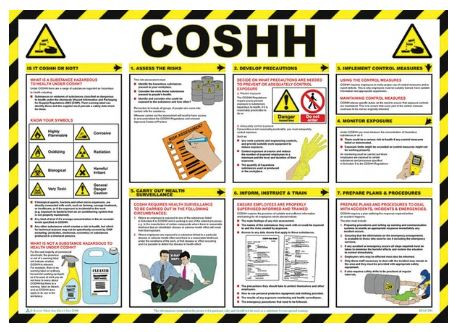
What does Coshh stand for?
COSHH stands for Control of Substances Hazardous to Health. The Control of Substances Hazardous to Health Regulations 2002, commonly known as the COSHH Regulations, require employers to assess and control exposure to substances that could cause ill health in the workplace.
Hazardous substances are not limited to obvious industrial chemicals. They can include cleaning products, paints, dusts, fumes, vapours, gases, mists and biological agents that employees may encounter as part of their work.
Understanding COSHH is therefore important for businesses of all sizes where substances that could harm health are used, handled, produced or stored.
What Does Each Letter in COSHH Mean?
COSHH stands for:
| Letter | Meaning |
| C | Control |
| O | Of |
| S | Substances |
| H | Hazardous to |
| H | Health |
The purpose of COSHH is to help prevent or adequately control exposure to substances that could damage a person's health.
What Are the COSHH Regulations?
The Control of Substances Hazardous to Health Regulations 2002 place duties on employers to protect employees and others who may be exposed to hazardous substances through work activities.
Employers need to identify potential health hazards, assess the risks and decide how exposure can be prevented or adequately controlled.
This may involve changing the substance or process being used, introducing engineering controls such as extraction or enclosure, changing working practices, providing suitable storage, supplying appropriate personal protective equipment where required, and ensuring employees receive relevant information, instruction and training.
Employers must also make sure that control measures remain effective and are properly maintained.
What Substances Are Covered by COSHH?
COSHH applies to many substances that could be harmful to health.
Examples can include:
- chemicals and products containing chemicals;
- cleaning and maintenance products;
- paints, coatings, solvents and adhesives;
- dust created through activities such as cutting, sanding or grinding;
- fumes produced during processes such as welding;
- gases and vapours;
- mists and sprays;
- biological agents and harmful micro-organisms; and
- substances generated as a result of a work process.
A substance does not necessarily need to arrive in a container carrying a hazard label to present a COSHH risk. Dust or fumes generated by a workplace process, for example, may also need to be assessed.
Lead, asbestos and radioactive substances are subject to their own specific regulations rather than being controlled through COSHH.
What Does an Employer Need to Do Under COSHH?
Employers should consider how hazardous substances are used or produced within the workplace and how people could be exposed to them.
A typical approach includes:
- Identify the hazardous substances used or produced in the workplace.
- Assess the risks to employees and anyone else who could be exposed.
- Prevent exposure where reasonably practicable, for example by removing the substance or using a safer alternative.
- Adequately control exposure where it cannot be prevented.
- Provide suitable control measures and make sure they are used correctly.
- Maintain and review control measures to ensure they remain effective.
- Provide employees with information, instruction and training.
- Monitor exposure and provide health surveillance where appropriate.
- Plan how accidents, spills and emergencies will be dealt with.
- Review the COSHH assessment when circumstances change or existing controls may no longer be effective.
The measures required will depend on the substances involved, the work being undertaken and the level of risk.
What Is a COSHH Risk Assessment?
A COSHH risk assessment examines the hazardous substances present in a workplace, how they could cause harm and what needs to be done to prevent or control exposure.
Employers should consider factors such as:
- what substances are being used or produced;
- their hazardous properties;
- how and where they are used;
- who could be exposed;
- how exposure could occur;
- how often exposure may take place;
- how much of the substance is involved;
- the existing control measures; and
- any further action needed.
Exposure can occur through breathing in dust, fumes, gases, vapours or mists, through contact with the skin or eyes, or in some circumstances by swallowing or other routes of entry.
Product labels and Safety Data Sheets (SDS) can provide useful information when identifying chemical hazards, although the COSHH assessment must consider how the substance is actually being used within the workplace.
For businesses with five or more employees, significant findings of the risk assessment must be recorded.
How Are Hazardous Substances Identified?
Hazardous chemical products may carry hazard pictograms and other information on their labels.
Chemical classification and labelling in Great Britain is governed by the GB Classification, Labelling and Packaging of Chemicals Regulation (GB CLP).
Depending on its classification, a chemical label may include:
- hazard pictograms;
- a signal word such as Danger or Warning;
- hazard statements explaining the nature of the hazard; and
- precautionary statements explaining measures that should be taken.
Employers should check product labels and Safety Data Sheets as part of identifying hazards, but should also consider hazardous substances generated by their own processes.
Need to Store Hazardous Substances Safely?
Correct storage can form part of the measures used to manage hazardous substances in the workplace.
Risk Assessment Products supplies a range of COSHH cabinets designed for secure workplace storage, alongside a wider selection of hazardous storage and spill containment equipment for commercial and industrial environments.
View Hazardous Storage & Spill Containment
How Should Hazardous Substances Be Stored?
There is no single storage arrangement suitable for every substance.
Storage requirements should be determined by the hazards involved, the quantities being stored, manufacturers' information, the Safety Data Sheet and the findings of the workplace risk assessment.
Considerations may include:
- keeping substances securely stored;
- preventing unauthorised access;
- keeping incompatible substances apart;
- protecting containers against damage;
- providing appropriate ventilation where required;
- containing leaks or spills;
- using suitable warning labels and signs;
- keeping containers closed when not in use; and
- having appropriate procedures for spills and emergencies.
Some dangerous substances can also present risks such as fire or explosion and may be subject to additional requirements, including the Dangerous Substances and Explosive Atmospheres Regulations 2002 (DSEAR).
Do I Need a COSHH Cabinet?
A COSHH cabinet is not automatically required simply because a business uses a substance covered by COSHH.
The correct storage arrangements should come from the risk assessment and take account of the properties of the substances being stored.
Where secure storage and containment are appropriate, a purpose-designed COSHH or hazardous substance cabinet can provide a practical way of controlling access and helping contain leaks or spillages.
COSHH cabinets are commonly used for substances such as certain:
- cleaning chemicals;
- maintenance chemicals;
- paints;
- adhesives;
- solvents; and
- other workplace substances requiring controlled storage.
Always check the relevant Safety Data Sheet and your risk assessment before deciding how a particular chemical should be stored. Different hazards may require different storage arrangements, and substances that are incompatible should not automatically be stored together simply because they are hazardous.
What Is the Difference Between a COSHH Assessment and a Safety Data Sheet?
A Safety Data Sheet and a COSHH risk assessment are not the same thing.
A Safety Data Sheet is supplied for certain hazardous chemical products and provides information about matters such as hazards, handling, storage and emergency measures.
A COSHH assessment considers how a hazardous substance is actually used or generated in your particular workplace, who could be exposed and what controls are needed.
A Safety Data Sheet can therefore provide important information for completing a COSHH assessment, but it does not replace the assessment itself.
What Control Measures Can Be Used Under COSHH?
The first objective should be to prevent exposure where reasonably practicable.
For example, it may be possible to stop using a particular hazardous substance, replace it with a less hazardous alternative or change the process.
Where exposure cannot be prevented, suitable controls may include:
- enclosed processes;
- local exhaust ventilation;
- general ventilation;
- safer systems of work;
- reducing the number of people exposed;
- limiting the duration or frequency of exposure;
- suitable storage and containment;
- appropriate cleaning and maintenance procedures;
- employee information and training; and
- suitable personal protective equipment where required.
The appropriate controls will depend on the individual risk assessment.
What Information and Training Should Employees Receive?
Employees who could be exposed to hazardous substances should receive appropriate information, instruction and training.
This should help them understand:
- which substances could harm them;
- the potential health risks;
- how exposure can occur;
- the control measures they must use;
- how substances should be handled and stored;
- what personal protective equipment is required, where applicable;
- how to recognise when controls may not be working correctly; and
- what to do in the event of a spill, accident or emergency.
Employees also need to follow the controls that have been put in place.
COSHH Workplace Checklist
When reviewing hazardous substances in your workplace, consider the following:
- Identify the substances that could cause harm.
- Check labels and Safety Data Sheets where applicable.
- Consider substances generated by workplace activities, such as dust and fumes.
- Assess who could be exposed and how.
- Prevent exposure wherever reasonably practicable.
- Control remaining exposure adequately.
- Store hazardous substances appropriately.
- Prepare for leaks, spillages and emergencies.
- Train employees in the risks and control measures.
- Maintain equipment and other control measures.
- Monitor exposure and undertake health surveillance where necessary.
- Review assessments and controls regularly and following significant changes.
COSHH Storage and Spill Control Equipment
The equipment needed will depend on your risk assessment and the substances involved.
For workplaces where hazardous liquids or chemicals need to be stored and managed, Risk Assessment Products offers equipment including:
COSHH Cabinets
Purpose-designed cabinets for secure storage of workplace hazardous substances, available in a range of sizes to suit different requirements.
Hazardous Storage
Storage solutions for commercial, industrial and workplace environments where chemicals and other hazardous materials need to be securely managed.
Shop Dangerous Substance Safety Cabinet
Spill Containment
Spill trays and other containment products can help contain leaks and accidental releases where appropriate to the substance and workplace risk.
Recent Posts
-
Workplace First Aid & Emergency Response: Is Your Business Properly Prepared?
Accidents and medical emergencies can happen in any workplace, from offices and schools to warehouse …23rd Oct 2026 -

Is One Defibrillator Enough? AED Coverage for Large UK Workplaces
Having a defibrillator on site is an important step towards workplace emergency preparedness. But wh …16th Oct 2026 -

Mobile First Aid Storage: Wheeled First Aid Cabinets for Large Workplaces
When an emergency happens, first aid equipment needs to be accessible, wherever the incident occurs. …8th Oct 2026