

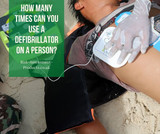
How many times can you use a defibrillator on a person?
In an emergency, you can use an automated external defibrillator (AED) as many times as the device advises. The AED analyses the person’s heart rhythm and will only recommend a shock when it believes a shockable rhythm is present. After each analysis, it will guide you through what to do next.
The most important thing is not “how many shocks” — it’s how quickly CPR and defibrillation start. Every minute without CPR and defibrillation can reduce the chance of survival by up to around 10%, which is why acting immediately matters.
What actually happens when you use an AED (and why it may shock more than once)
Most public-access AEDs work in repeating cycles:
- The AED analyses the heart rhythm.
- If a shock is advised, it instructs you to deliver it (or delivers automatically on some models).
- It then tells you to restart CPR straight away.
- After a set period (commonly about two minutes), it re-analyses and may advise another shock.
This is why it’s completely possible for an AED to advise multiple shocks during one resuscitation attempt. You simply keep following the prompts.
UK best practice: single shocks, then CPR
UK resuscitation guidance for defibrillation follows a “single shock, then immediate CPR” approach in most situations. In clinical algorithms, a shock is followed by a two-minute cycle of chest compressions before rhythm re-assessment; “stacked shocks” (multiple back-to-back shocks) are reserved for specific, highly monitored scenarios.
For a bystander using an AED, the practical takeaway is simple: do what the AED says, and minimise pauses in chest compressions.
When should you stop using the AED / stop CPR?
If you’ve attached an AED and started CPR, UK public guidance is to continue until:
- the AED asks you to pause for re-analysis (and it may advise another shock),
- a paramedic arrives and takes over / tells you what to do,
- or the person shows clear signs of life.
If you’re alone and getting exhausted, swap with another bystander if possible and keep interruptions to compressions as short as you can. (The emergency call handler can also coach you through CPR.)
A common worry: Can I harm someone by using an AED too many times?
In practice, an AED is designed to reduce the risk of inappropriate shocks by analysing the rhythm and only advising a shock when indicated. Your job is to:
- switch it on,
- apply pads as shown on the pictures,
- stand clear when told,
- and follow the voice prompts.
What you may need to replace after using a defibrillator
- This is where “how many times” does matter, for the kit.
- Electrode pads are single-use and should be replaced after each use.
- Pads and batteries also have expiry dates, so routine checks matter (many organisations do a quick weekly visual check).
Practical tip for workplaces and venues: keep a spare set of pads on site so the AED can be made “rescue-ready” again quickly after an incident.
Want more information, see our recent article how often should a defibrillator (AED) be checked?
Tip: Register your AED on The Circuit
If you’re responsible for an AED at work or in the community, registering it on The Circuit helps ambulance services locate it when someone calls 999.
If you’d like help with your defibrillator enquiry, please contact us by email at sales@risk-assessment-products.co.uk
Recent Posts
-
How many times can you use a defibrillator on a person?
In an emergency, you can use an automated external defibrillator (AED) as many times as the device a …15th Feb 2026 -

What is CPR?
Knowing the basics of first aid and how to deliver CPR (cardiopulmonary resuscitation) can make the …17th Nov 2024 -

What is a sudden cardiac arrest (SCA)?
Sudden Cardiac Arrest (SCA) is a critical medical emergency where the heart abruptly ceases to funct …17th Nov 2024