
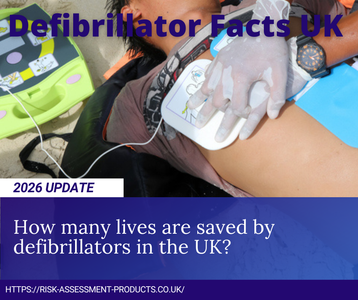
How many lives are saved by defibrillators in the UK?
Defibrillators are an essential part of the emergency response to out-of-hospital cardiac arrest (OHCA). However, the UK does not publish a single national figure for “lives saved by defibrillators alone”, because survival depends on multiple linked steps: early recognition, calling 999, immediate CPR, early defibrillation (by a public AED and/or ambulance crews), and subsequent hospital care.
Instead, the most reliable way to describe the impact of defibrillators is to use published UK data on:
- how often out-of-hospital cardiac arrest occurs,
- survival rates,
- public access defibrillator (PAD) use,
- and the effect of early defibrillation.
UK headline figures on out-of-hospital cardiac arrest
The British Heart Foundation (BHF) reports that in the UK there are over 30,000 out-of-hospital cardiac arrests each year where emergency medical services attempt resuscitation, and that the survival rate is less than 1 in 10.
These figures help explain why public CPR knowledge and rapid access to an AED are repeatedly highlighted in UK cardiac arrest strategy and guidance.
England’s OHCA outcomes reporting (a “lives saved” view)
England’s Out-of-Hospital Cardiac Arrest Outcomes (OHCAO) programme provides detailed annual reporting. In the English Ambulance Services 2024 overview (published by the University of Warwick), the report shows:
- 29,241 resuscitation attempts recorded (with a note that one ambulance service did not submit 2024 data),
- 30-day survival: 9.5% (all cases),
- “Lives saved”: 2,738 (as presented in the infographic summary),
- Public Access Defibrillator (PAD) use: 7.9%,
- Median EMS response time: 7.2 minutes.
What that does (and doesn’t) mean
- The 2,738 “lives saved” figure reflects people who survived to 30 days in the reported cohort — it is not a count of people saved by public defibrillators alone.
- The 7.9% PAD use statistic shows that public defibrillators are used in a minority of cases, indicating scope to increase early defibrillation before ambulance arrival.
Why early defibrillation is time-critical
Survival in cardiac arrest falls rapidly with delay. BHF states that every minute without CPR and a defibrillator reduces survival chances by up to 10%.
Resuscitation Council UK states that defibrillation within 3–5 minutes of collapse may produce survival rates as high as 50–70% in some circumstances.
These statements are widely used in UK resuscitation education because they summarise the central point: fast CPR plus early defibrillation offers the best chance of survival when a shockable rhythm is present.
What a defibrillator (AED) does
An automated external defibrillator (AED) analyses the heart rhythm and, when appropriate, advises or delivers a shock to treat certain life-threatening rhythms. Publicly accessible devices are often described as Public Access Defibrillators (PADs), designed to be used by members of the public with voice prompts and illustrated pad placement.
How many defibrillators are there in the UK?
UK Parliamentary written answers have cited BHF figures showing rapid growth in the national AED register. A written answer dated 22 July 2025 states there are over 110,000 defibrillators registered on The Circuit, and 58.6% are accessible 24 hours a day, seven days a week.
This matters because an AED that is inaccessible (for example, locked inside a building outside opening hours) is less likely to be usable when needed.
The Circuit: improving “findability” in a 999 call
BHF describes The Circuit as the UK’s national defibrillator network, mapping registered defibrillators so ambulance services can locate the nearest registered AED when a bystander calls 999.
NHS England also emphasises that registering a community, workplace or school defibrillator on The Circuit helps emergency call handlers direct bystanders to the nearest device during a 999 call.
What to do if someone collapses (UK actions)
If you think someone is in cardiac arrest (unresponsive and not breathing normally):
- Call 999 (put your phone on loudspeaker).
- Start chest compressions.
- If others are present, send someone to fetch the nearest AED.
- Turn it on and follow the prompts. Continue CPR between analyses until help arrives or the person shows clear signs of life.
Several UK ambulance services state that their emergency operations staff can direct 999 callers to the nearest defibrillator and may provide a cabinet code where necessary.
Summary: what the evidence supports
Based on UK-published sources:
- Out-of-hospital cardiac arrest survival in the UK is less than 1 in 10 overall.
- England’s OHCAO reporting for 2024 presents 2,738 30-day survivors (“lives saved”) in the reported cohort, with PAD use at 7.9%.
- Early CPR and early defibrillation are time-critical; survival can fall by up to 10% per minute without them, and defibrillation within 3–5 minutes may be associated with 50–70% survival in some circumstances.
- There are 110,000+ defibrillators registered on The Circuit, and 58.6% are reported as 24/7 accessible.
Practical steps to improve the chance an AED is used in time
For organisations and communities, UK guidance and reporting supports four practical measures:
- Register the AED on The Circuit and keep details up to date.
- Aim for 24/7 access where possible (for example, an external cabinet), to reduce delays.
- Use clear signage so the AED can be found quickly.
- Make readiness checks routine (pads and batteries expire; accessibility information must be current).
Recent Posts
-
How many lives are saved by defibrillators in the UK?
Defibrillators are an essential part of the emergency response to out-of-hospital cardiac arrest (OH …3rd Apr 2026 -
How many times can you use a defibrillator on a person?
In an emergency, you can use an automated external defibrillator (AED) as many times as the device a …15th Feb 2026 -

What is CPR?
Knowing the basics of first aid and how to deliver CPR (cardiopulmonary resuscitation) can make the …17th Nov 2024