
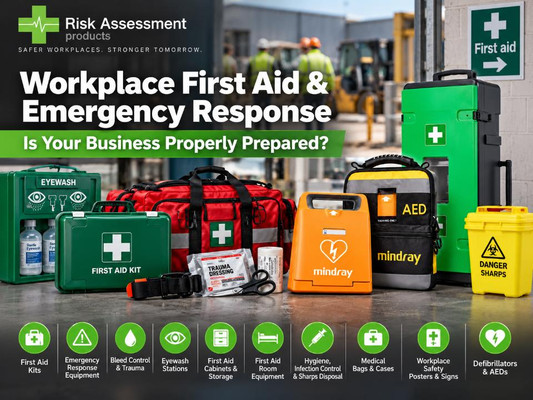
Workplace First Aid & Emergency Response: Is Your Business Properly Prepared?
Accidents and medical emergencies can happen in any workplace, from offices and schools to warehouses, factories, construction sites, healthcare facilities and public buildings.
Having first aid equipment available is important, but effective workplace preparedness involves more than keeping a first aid kit in a cupboard.
Employers also need to consider:
- the hazards within the workplace;
- the number and location of people on site;
- how quickly first aid equipment can be reached;
- whether specialist emergency equipment is required;
- how supplies are stored;
- who is responsible for maintaining them; and
- whether arrangements still suit the business as the workplace changes.
Risk Assessment Products supplies a wide range of First Aid & Emergency Response Equipment to help organisations build first aid arrangements around their actual workplace needs.
What Are UK Employers Required to Provide?
Under the Health and Safety (First-Aid) Regulations 1981, employers must provide adequate and appropriate first aid equipment, facilities and personnel so employees can receive immediate assistance if they are injured or become ill at work.
The appropriate level of provision should come from a first-aid needs assessment.
That assessment should consider factors such as:
- workplace hazards;
- workforce size;
- how employees are distributed around the site;
- lone and remote working;
- shift patterns;
- accident history;
- proximity to emergency medical services;
- separate buildings or work areas;
- people other than employees who may be present.
A small office will therefore usually have very different requirements from a construction site, manufacturing facility or large distribution centre.
How Does BS 8599-1:2019+A1:2026 Affect Workplace First Aid?
The current British Standard is BS 8599-1:2019+A1:2026.
The 2026 amendment expands the scope of BS 8599-1 so that it now covers both:
workplace first aid kit contents
and
the provision of Automated External Defibrillators (AEDs) in the workplace.
The standard can help employers and procurement teams benchmark workplace first aid provision, particularly when choosing first aid kits and reviewing AED arrangements.
However, BS 8599-1 is not legislation.
Employers still need to base their first aid arrangements on the findings of their first-aid needs assessment.
This distinction is important.
A workplace should not simply buy a British Standard kit and assume that every first aid requirement has been covered.
The workplace may also need:
- additional first aid kits;
- trauma or bleed-control equipment;
- eyewash;
- burns supplies;
- defibrillators;
- mobile first aid storage;
- first aid room equipment;
- sharps or infection-control products.
The correct combination depends on the risks and environment.
1. Workplace First Aid Kits - The Starting Point
A suitably stocked and accessible first aid kit remains the foundation of most workplace first aid arrangements.
Different workplaces may need different kit types and quantities.
Risk Assessment Products supplies first aid kits for requirements including:
- general workplace use;
- vehicles;
- catering environments;
- schools and education;
- sports;
- personal and home use;
- specialist workplace applications.
The number of kits also matters.
A single first aid kit may be sufficient in a small workplace, while larger buildings, multiple departments or remote working areas may require several strategically positioned kits.
Should You Choose a BS 8599 Workplace First Aid Kit?
A BS 8599-aligned kit can provide a useful recognised specification for workplace first aid supplies.
However, HSE does not require every employer to use a BS 8599 kit.
The most important consideration is that the kit contents are appropriate for the workplace risks identified in the first-aid needs assessment.
For some workplaces, that means starting with a standard kit and adding more specialist equipment.
2. Emergency Response Equipment - Preparing for More Serious Incidents
Some workplaces face situations that go beyond routine cuts, sprains and minor injuries.
Emergency response equipment may help organisations prepare for more serious or unusual incidents.
Depending on the site, this might include equipment for:
- rescue situations;
- larger incidents;
- specialist first-aid response;
- emergency evacuation;
- industrial environments;
- remote working areas.
Construction, utilities, industrial operations and larger facilities should consider the emergency scenarios most relevant to their activities rather than relying solely on standard first aid supplies.
Explore Emergency Response Equipment
3. Bleed Control & Trauma Equipment
Severe bleeding can become life-threatening quickly.
Workplaces involving machinery, sharp tools, manufacturing processes, construction work or significant public footfall may want to consider whether additional trauma equipment is appropriate.
RAP's range includes products such as:
- bleed-control kits;
- Public Access Trauma kits;
- tourniquets;
- trauma dressings;
- trauma storage;
- bleed-control cabinets.
This equipment should supplement wider first aid provision rather than replace it.
Suitable training, emergency procedures and regular equipment checks should also form part of the arrangement.
Browse Bleed Control & Trauma Equipment
4. Eyewash Stations and Emergency Eye Care
Workplaces involving chemicals, dust, debris and other eye hazards may need dedicated emergency eyewash provision.
Potential environments include:
- laboratories;
- workshops;
- manufacturing facilities;
- construction sites;
- engineering departments;
- maintenance areas.
Options may include:
- eyewash bottles;
- wall-mounted stations;
- portable eyewash;
- dedicated emergency eye-treatment points.
The appropriate solution depends on the substances and hazards involved.
For some chemical risks, a plumbed emergency eyewash or shower may be required rather than relying solely on portable bottles.
5. First Aid Cabinets & Storage
Buying the correct first aid equipment is only useful if people can find it quickly.
First aid cabinets and storage can help organisations keep supplies:
- organised;
- protected;
- clearly located;
- easier to inspect;
- ready for use.
Different workplaces may benefit from:
- wall-mounted first aid cabinets;
- metal medical cabinets;
- first aid lockers;
- high-capacity storage;
- workstations;
- mobile first aid storage.
Explore First Aid Cabinets & Storage
Mobile First Aid Storage for Larger Sites
Large workplaces create a particular challenge.
If emergency equipment is located hundreds of metres away from an incident, staff may lose valuable time retrieving it.
Mobile first aid storage can help organisations bring larger quantities of emergency equipment to the casualty rather than relying entirely on fixed storage points.
This can be particularly useful in:
- warehouses;
- construction sites;
- factories;
- educational campuses;
- sports venues;
- large public facilities.
RAP now supplies wheeled first aid response boxes designed for mobile emergency equipment storage.
Browse Mobile First Aid Storage
6. First Aid Stations - Create a Visible Response Point
In busy workplaces, first aid equipment can become difficult to locate if supplies are spread between cupboards or departments.
A dedicated first aid station provides a clearly identifiable response point.
Depending on the configuration, a station may bring together:
- first aid supplies;
- eyewash;
- burns products;
- PPE;
- emergency information.
This can be particularly useful in warehouses, workshops, factories and larger workplaces where visibility matters.
7. First Aid Trolleys
Where equipment needs to move regularly between rooms or departments, a first aid trolley can provide a more flexible alternative to fixed storage.
Trolleys can be useful in:
- larger workplaces;
- healthcare environments;
- education;
- industrial premises;
- event facilities.
The advantage is organisation combined with mobility.
8. Defibrillators and the 2026 British Standard Update
Automated External Defibrillators are now explicitly addressed within BS 8599-1:2019+A1:2026.
That makes AED provision increasingly relevant when organisations review wider workplace first aid arrangements.
There is still no blanket UK legal requirement for every employer to install a defibrillator.
However, employers should consider factors such as:
- site size;
- number of people present;
- workforce age profile;
- distance from emergency medical services;
- accessibility;
- whether an existing AED can be reached quickly enough.
Large or dispersed sites may also need to consider whether one AED provides adequate coverage.
Risk Assessment Products supplies:
- defibrillator machines;
- AED packages;
- cabinets;
- signs;
- replacement pads;
- replacement batteries.
You can also read:
BS 8599-1:2019+A1:2026: What the New Workplace AED Guidance Means
and use our:
Free Defibrillator Site Assessment Form
9. First Aid Room Equipment
Some workplaces may need a dedicated first aid room.
Whether one is appropriate depends on factors such as:
- workforce size;
- workplace hazards;
- site layout;
- incident history;
- first aid demand.
A first aid room may require:
- examination or treatment couches;
- cabinets;
- storage;
- suitable seating;
- waste facilities;
- appropriate signage.
Large industrial workplaces, distribution centres, education settings and higher-risk sites may be more likely to require dedicated treatment facilities.
Browse First Aid Room Equipment
10. Hygiene, Infection Control & Sharps Disposal
First aiders can also face contamination risks when assisting casualties.
Workplaces may therefore need products for:
- bodily fluid spills;
- sharps disposal;
- cleaning;
- waste management;
- PPE;
- infection control.
These products may be particularly relevant in:
- healthcare;
- education;
- leisure facilities;
- public buildings;
- hospitality;
workplaces where sharps or contamination risks exist.
Browse Hygiene, Infection Control & Sharps Disposal
11. Medical Bags & Cases
Not every incident happens next to a first aid cabinet.
Portable medical bags and cases can help responders carry equipment to the casualty while keeping supplies organised.
They can be useful for:
- first responders;
- sports teams;
- mobile workers;
- schools;
- remote sites;
- events;
- larger workplaces.
Different configurations allow organisations to choose storage suited to the amount and type of equipment being carried.
12. Workplace Safety Posters & Signs
Emergency equipment needs to be easy to identify.
Clear signage can help people locate:
- first aid kits;
- treatment areas;
- AEDs;
- eyewash;
- emergency equipment.
Posters can also support awareness of first aid procedures and reinforce key workplace safety messages.
Signs and posters should support - not replace - appropriate training and emergency procedures.
Browse Workplace Safety Posters & Signs
How Should You Build a Complete Workplace First Aid System?
The most effective approach is to think about first aid provision as a system, not a shopping list.
A practical review should cover six areas.
1. Equipment
Do the available first aid supplies reflect the hazards identified?
2. Accessibility
Can people reach the necessary equipment quickly?
3. Coverage
Are supplies located across the areas where they are most likely to be needed?
4. Storage
Are products protected, organised and clearly identified?
5. Maintenance
Are contents checked, replenished and replaced before expiry?
6. Training and Responsibility
Do staff know:
- who the first aiders are;
- where equipment is located;
- who is responsible for maintaining it;
- what to do during an emergency?
First Aid Provision for Different Workplace Types
Different environments should not be equipped identically.
Offices
May require:
- workplace first aid kits;
- accessible storage;
- signage;
- AED provision where appropriate.
Warehouses & Distribution Centres
May need:
- multiple first aid kits;
- mobile first aid storage;
- bleed-control equipment;
- eyewash;
- visible response stations;
- AEDs across larger sites.
Construction Sites
May require:
- first aid kits;
- trauma provisions;
- eyewash;
- burns products;
- mobile response equipment;
- AEDs;
changing locations as the project progresses.
Manufacturing & Engineering
May need:
- workplace kits;
- trauma products;
- eyewash;
- burns equipment;
- mobile or fixed first aid stations;
dedicated first aid rooms where assessment identifies the need.
Schools & Education
May benefit from:
- school first aid kits;
- portable response bags;
- first aid cabinets;
- mobile storage;
- sports first aid supplies;
- AEDs.
Public Venues
May need to consider:
- first aid stations;
- trauma provision;
- mobile emergency supplies;
- medical response bags;
- signage;
- publicly accessible AEDs.
Frequently Asked Questions
What first aid equipment does a UK workplace need?
There is no single equipment list suitable for every workplace.
Employers should base first aid provision on a first-aid needs assessment considering workplace hazards, workforce size, layout and other relevant factors.
Does a workplace first aid kit have to comply with BS 8599?
No.
HSE states that employers may refer to BS 8599, but kit contents should ultimately reflect the findings of the first-aid needs assessment.
What changed in BS 8599-1 in 2026?
BS 8599-1:2019+A1:2026 now covers workplace first aid kit contents and workplace AED provision.
Does every workplace need an AED?
There is no general UK legal requirement for every workplace to install an AED.
AED provision should be considered according to the workplace's needs, risks, size and accessibility.
How many first aid kits should a workplace have?
There is no universal number.
Larger, multi-building or dispersed sites may need several kits so equipment remains accessible.
Does a large workplace need mobile first aid storage?
Not automatically, but mobile storage can be useful where fixed equipment would take too long to reach or where emergency supplies need to move between operational areas.
Do workplaces need bleed-control kits?
There is no blanket requirement for every workplace.
They may be appropriate where the first-aid needs assessment identifies a significant risk of serious bleeding or where enhanced emergency preparedness is required.
When is a first aid room required?
The need depends on the size and nature of the workplace and should be determined through the first-aid needs assessment.
Review Your First Aid & Emergency Response Provision
Workplace first aid should not be treated as a one-off purchase.
As organisations grow, move premises, introduce new machinery or change working practices, first aid requirements can also change.
A regular review should ask:
- Are our first aid kits still appropriate?
- Can employees reach them quickly?
- Do we need specialist trauma or eyewash equipment?
- Is our storage suitable?
- Would mobile response equipment improve coverage?
- Do we need an AED or additional AEDs?
- Are all supplies inspected and maintained?
- Does everyone know where emergency equipment is located?
Risk Assessment Products supplies equipment across the complete workplace first aid and emergency-response journey, including:
- First Aid Kits
- Emergency Response Equipment
- Bleed Control & Trauma
- Eyewash Stations
- First Aid Cabinets & Storage
- First Aid Room Equipment
- Hygiene, Infection Control & Sharps Disposal
- Medical Bags & Cases
- Workplace Safety Posters & Signs
- Defibrillators
Browse All First Aid & Emergency Response Equipment
For larger facilities, multi-site organisations or workplaces with more complex risks, contact Risk Assessment Products for help identifying suitable equipment for your requirements.
Contact Risk Assessment Products
Recent Posts
-
Workplace First Aid & Emergency Response: Is Your Business Properly Prepared?
Accidents and medical emergencies can happen in any workplace, from offices and schools to warehouse …23rd Oct 2026 -
Is One Defibrillator Enough? AED Coverage for Large UK Workplaces
Having a defibrillator on site is an important step towards workplace emergency preparedness. But wh …16th Oct 2026 -
Mobile First Aid Storage: Wheeled First Aid Cabinets for Large Workplaces
When an emergency happens, first aid equipment needs to be accessible, wherever the incident occurs. …8th Oct 2026