Access depends on how the AED has been installed. An unlocked cabinet can be opened directly, while a coded cabinet requires the relevant access code.
Emergency services should be contacted immediately when cardiac arrest is suspected. The emergency call handler can provide instructions while CPR and defibrillator retrieval are organised.
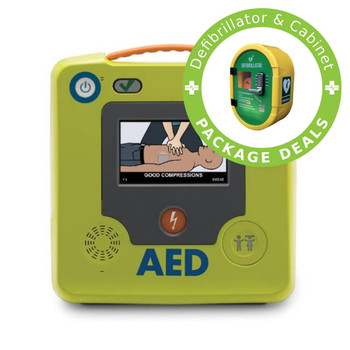
A community AED installation usually requires more than the defibrillator itself. Depending on the location and package selected, this can include the AED, electrode pads, battery, carrying case, rescue kit, cabinet and appropriate signage.
Our defibrillator packages bring together AEDs and selected accessories for different installations.
Do community defibrillator pads and batteries need replacing?
Yes. AED electrode pads have an expiry date and normally require replacement after use. Batteries also have a specified service life, which varies by manufacturer and model.
Replacement consumables must be compatible with the AED. Browse our defibrillator pads and defibrillator batteries.
Should a community defibrillator be registered?
Public-access defibrillators can be registered with the national defibrillator network so ambulance services are aware of their location and availability. Registration information should be kept up to date when details such as access, availability or equipment change.
Is a fully automatic or semi-automatic AED better for a community location?
Both types analyse the casualty's heart rhythm and determine whether a shock is required. A semi-automatic AED instructs the user to press a shock button, while a fully automatic AED delivers the shock automatically after providing warnings and allowing people to move clear.
You can compare our fully automatic defibrillators and semi-automatic defibrillators when selecting an AED for a community location.